Rare 1943 archival photograph capturing a captured French Somua S35 medium tank in German service (Pz.Kpfw. 35S 739(f)) smoking after being destroyed by Soviet partisans in the Leningrad region.
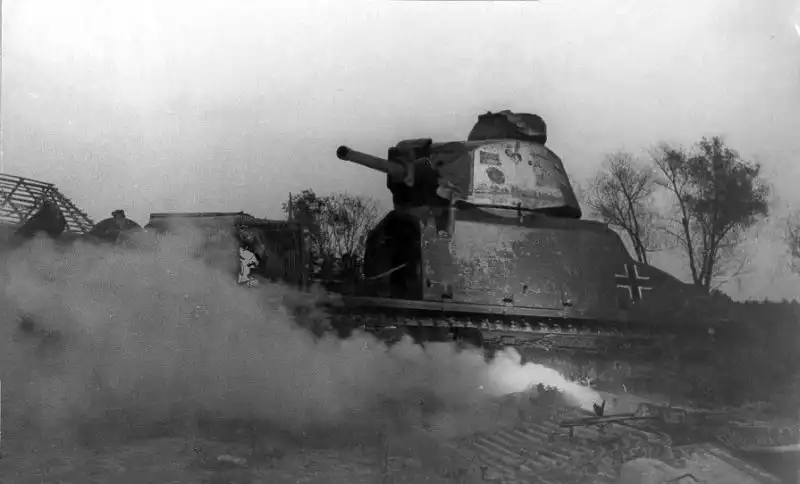
Captured French Somua S35 Tank Destroyed by Soviet Partisans in Leningrad Region (1943)
This extraordinarily rare photograph from 1943 records a unique episode of irregular warfare on the Eastern Front, showing a former French Somua S35 medium tank in German service smoking heavily after being ambushed and destroyed by Soviet partisans in the occupied Leningrad Region.
Following the fall of France in June 1940, the German Wehrmacht captured approximately 300 to 400 Somua S35 tanks, redesignating them as Pz.Kpfw. 35S 739(f) and assigning them primarily to security divisions (Sicherungs-Divisionen), anti-partisan units, and armored train protection duties in eastern occupied territories.
Equipment, Uniforms, and Visual Features
The image provides exceptional visual documentation of captured trophy armor (Beutepanzer) modified for security duties along rear communication lines:
- Vehicle Identification and Cast Hull: The profile clearly exhibits the Somua S35's distinct cast armor hull sections joined by heavy bolts, alongside the single-man APX 1 CE turret housing a 47 mm SA 35 main gun.
- Wehrmacht Insignia: A high-contrast German Balkenkreuz (national cross) is prominently painted on the right side of the hull armor to prevent friendly fire incidents by Luftwaffe or anti-tank units.
- Combat Damage and Smoke Effects: Heavy white and dark smoke billows from the lower chassis and engine compartment, indicating an internal fire or secondary explosion triggered by a partisan landmine or close-range anti-tank grenade attack.
- Rear Security Deployment Context: Background structures suggest the ambush occurred near a rural settlement or railway link, typical operating environments for German anti-partisan sweeps.
Beutepanzer Usage in Anti-Partisan Warfare
Due to their thick armor and relatively low speed, captured French tanks were poorly suited for front-line armored clashes against modern Soviet T-34s. However, German occupation authorities found them highly valuable for patrolling supply corridors and suppressing partisan uprisings. Soviet partisan detachments frequently targeted these isolated armor patrols using improvised explosive devices, anti-tank rifles, and coordinated ambushes.
📍 Location: Leningrad Region, USSR
📅 Date: 1943
📷 Photographer: Unknown
📰 Primary Source: Historical Eastern Front partisan warfare archive
Recommended reading:
- Trophy armor history: Operational deployment of captured French tanks (Beutepanzer) in the Wehrmacht
- French medium armor: Technical design and combat performance of the Somua S35
- Partisan tactics: How Soviet irregular forces ambushed German armored patrols in 1942–1943
- Security divisions: Organization and equipment of German Sicherungs-Divisionen on the Eastern Front