Exceptional 1942 photograph by Sergey Loskutov capturing Soviet partisans in the occupied Leningrad region armed with British Lee-Enfield (SMLE) rifles and cold weapons before a patrol.
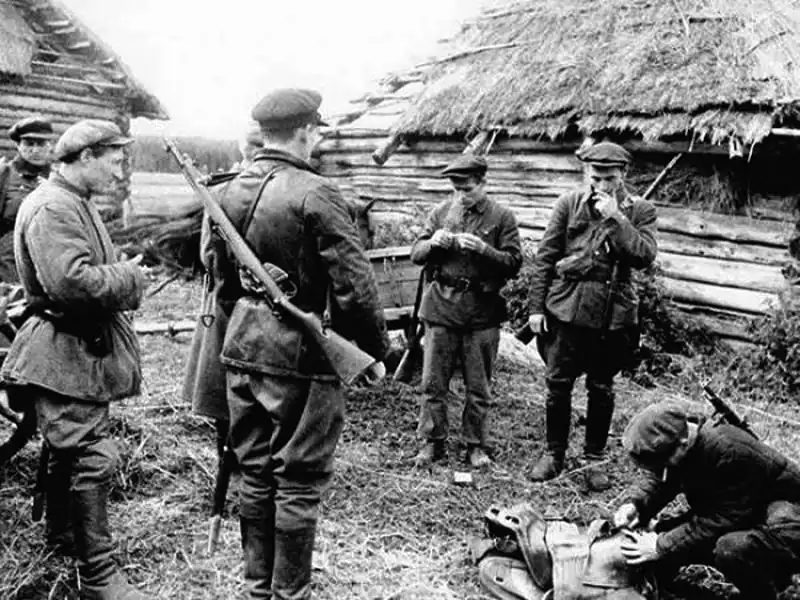
Soviet Partisans Preparing for Combat Reconnaissance (Leningrad Region, 1942)
This remarkable wartime photograph taken in 1942 by Soviet photojournalist Sergey Loskutov shows a reconnaissance element of Soviet partisans assembling in a rural village within the German-occupied Leningrad region. The fighters are making final equipment adjustments, packing horse saddles, and rolling cigarettes prior to departing on a long-range intelligence patrol in the enemy rear.
Beyond its human narrative, the photograph serves as an extraordinary visual record of the diverse, non-standard small arms and bladed weapons utilized by Soviet irregular forces during the early stages of the Great Patriotic War.
Foreign Arms Diversity: The British Lee-Enfield (SMLE) in Partisan Hands
The prominent bolt-action rifle slung across the back of the foreground partisan is a British Short Magazine Lee-Enfield (SMLE) firing the .303 British cartridge. The presence of these rifles in the Leningrad region stems from several distinct historical vectors:
- Civil War and Intervention Stocks (1918–1919): Large quantities of SMLE rifles were captured by the Red Army from British forces and White Guard armies during Allied intervention in Northern Russia (Arkhangelsk and Murmansk), subsequently placed in reserve storage.
- Baltic Military Integration (1940): Following the incorporation of Estonia, Latvia, and Lithuania into the USSR in 1940, small arms arsenals from their respective national armies—which heavily featured interwar British military imports—were absorbed into Red Army stockpiles.
- Emergency Issue in Leningrad (1941): Facing critical small arms shortages during the Siege of Leningrad, military authorities issued reserve Lee-Enfield rifles to the People's Volunteer Corps (Narodnoe Opolcheniye), naval infantry units, and frontline forces deployed to the famous Nevsky Pyatachok bridgehead, from where they filtered into local partisan brigades.
Cold Weapons and Equipment Integration
The image highlights the eclectic tactical gear characteristic of early partisan detachments:
- Bladed Weapons: In addition to bolt-action rifles, partisans are equipped with traditional Soviet cavalry sabers (shasqua) and combat trench knives, essential for silent reconnaissance operations and close-quarters sentry removal.
- Equestrian Saddles: The foreground partisan adjusting horse tackle reflects the reliance of forest detachments on mounted reconnaissance patrols for rapid movement across roadless marshlands and dense taiga terrain.
📍 Location: Leningrad Region, Russian SFSR, Soviet Union
📅 Date: 1942
📷 Photographer: Sergey Loskutov (Soviet War Correspondent)
📰 Primary Source: WWII Soviet Partisan Movement Records / Central State Archive of Film and Photo Documents
Recommended reading:
- Foreign small arms and non-standard rifles in Red Army reserve arsenals (1941–1942)
- Combat history of British Lee-Enfield (SMLE) rifles on the Eastern Front
- Equipment, organization, and logistics of Leningrad region partisan brigades
- Supplying the People's Volunteer Corps during the Defense of Leningrad