Dramatic winter photograph by Georgy Lipskerov showing Soviet Red Army infantry in snow camouflage suits pinned down near a damaged 76.2mm 3-K anti-aircraft gun during the Battle of Stalingrad.
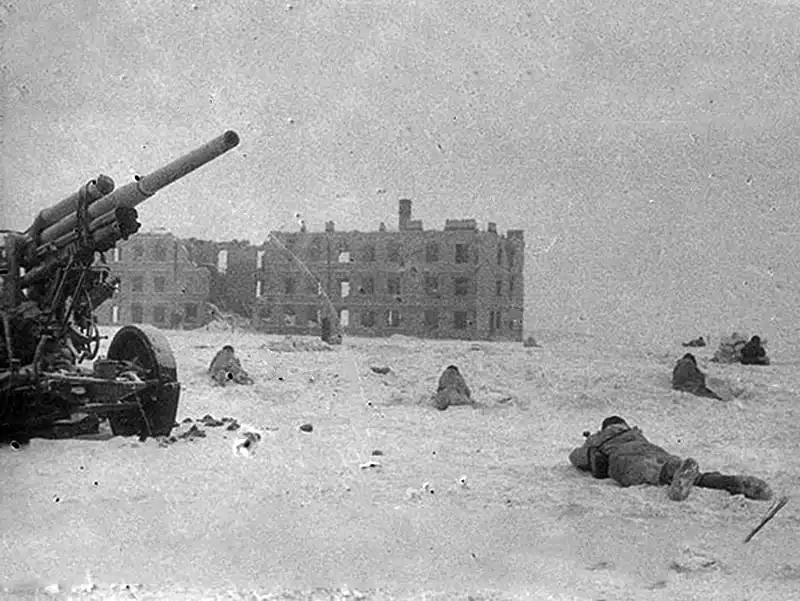
Soviet Infantry in Winter Urban Combat at Stalingrad (1942–1943)
This striking frontline photograph, captured by celebrated Soviet photojournalist Georgy Lipskerov, records the grim reality of urban warfare during the winter phase of the Battle of Stalingrad (late 1942 – early 1943). Red Army infantrymen, clad in white winter camouflage suits (maskhalat), are pinned down in deep snow under enemy fire while advancing across an open industrial wasteland toward ruined urban structures.
The composition vividly illustrates the extreme exposure and hazardous conditions faced by assault groups operating within the heavily contested industrial districts and squares of the city.
The 76.2 mm Anti-Aircraft Gun Model 1931 (3-K)
A notable technical element on the left side of the photograph is a damaged Soviet 76.2 mm anti-aircraft gun M1931 (3-K) left in its limbered traveling position:
- Technical Specifications: Developed in the early 1930s based on a Rheinmetall design, the 3-K was the primary heavy anti-aircraft piece of the Red Army in the early years of World War II, mounted on a four-wheeled ZU-13 trailer.
- Dual Anti-Tank Role: During the defense of Stalingrad, anti-aircraft batteries were frequently pressed into direct-fire anti-tank roles against advancing Wehrmacht armor when main artillery reserves were depleted.
- Traveling Position: The barrel locked back onto its carriage indicates the piece was caught in transit during rapid urban shifts or shelling before it could be deployed into firing posture.
Tactics of Winter Assault Groups in Stalingrad
Winter operations required specialized infantry gear and small-unit coordination:
- Camouflage Integration: The two-piece white camouflage suits were vital for breaking individual human silhouettes against snow-covered rubble, reducing effectiveness of enemy snipers and machine-gun nests.
- Assault Tactics: Lacking heavy armor cover on open approaches, Soviet infantry relied on low-profile crawling, short fire-and-maneuver rushes, and close support from submachine gunners and light mortar teams to close in on fortified buildings.
📍 Location: Stalingrad, Russian SFSR, Soviet Union
📅 Date: Winter 1942–1943
📷 Photographer: Georgy Lipskerov (TASS War Correspondent)
📰 Primary Source: WWII Soviet Photographic Archives / State Film and Photo Archive
Recommended reading:
- Technical development and combat deployment of the 76.2 mm anti-aircraft gun 3-K
- Urban combat tactics of Red Army winter assault groups in Stalingrad
- The war photojournalism and composition style of Georgy Lipskerov
- Winter clothing logistics and camouflage equipment of the Red Army (1942–1943)