Famous and controversial July 1943 archival photo depicting a Waffen-SS soldier giving water from a field canteen to a severely wounded Soviet T-34 crewman during the Battle of Kursk.
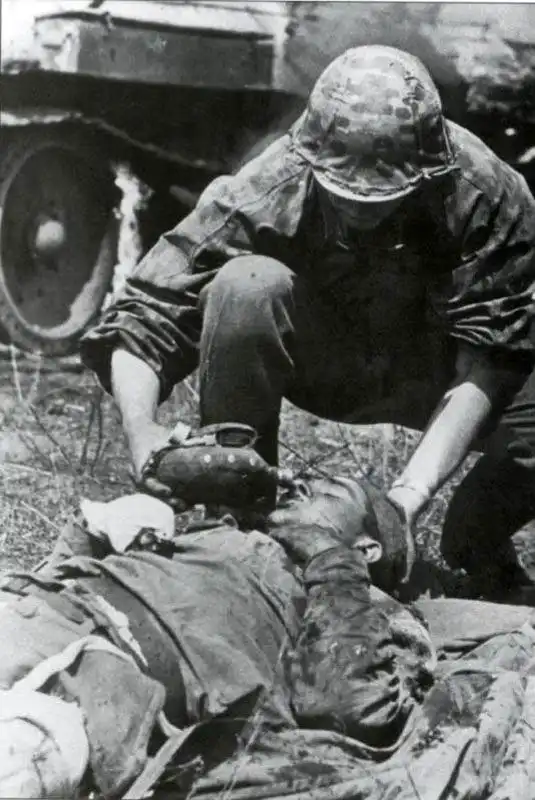
Waffen-SS Grenadier and Wounded Soviet Tanker During the Battle of Kursk (July 1943)
This iconic and widely debated archival photograph from July 1943 captures a Waffen-SS soldier kneeling alongside a severely burned Soviet tank crewman on the battlefield of the Battle of Kursk. The SS grenadier is seen supporting the wounded soldier's head while offering water directly from a standard German aluminum field canteen (Feldflasche 31). In the background, the scorched hull and roadwheels of a knocked-out T-34 medium tank remain visible.
This image forms the second frame in a known historical sequence documenting the encounter between German frontline units and surviving Red Army armored personnel during the heavy engagements on the Southern Front (Prokhorovka–Belgorod sector).
Propaganda Staging vs. Frontline Reality
Military historians and archival analysts offer differing interpretations regarding the context and motivation behind the photograph:
- Waffen-SS Propaganda Company (Propagandakompanie): Many researchers argue the series was choreographed by German war correspondents (Kriegsberichter) attached to elite SS armored divisions (such as 1st SS "LSSAH", 2nd SS "Das Reich", or 3rd SS "Totenkopf"). Such images were utilized in wartime periodicals like Signal to present a sanitized, chivalrous depiction of Axis forces operating on the Eastern Front.
- Humanitarian Impulse in Combat: Conversely, battlefield accounts record isolated instances where individual combatants rendered basic medical aid or water to mortally wounded enemy soldiers during brief lulls in heavy armored engagements.
- Uniform and Camouflage Identification: The German soldier is wearing specialized Waffen-SS camouflage gear, including a spotted camouflage smock (Tarnjacke) and a matching helmet cover (Tarnbezug) worn over field-gray service dress. The Soviet crewman wears a standard padded tank helmet (shlemofon) and scorched overalls.
Historical Legacy of the Kursk Armored Battle
The Battle of Kursk (Operation Citadel) represented the largest clash of armored fighting vehicles in military history. The extreme intensity of close-range tank duels resulted in massive personnel casualties on both sides, with burned tank crews receiving immediate aid only when field dressing stations could be established following the collapse of defensive lines.
📍 Location: Kursk Salient (Southern Front), USSR
📅 Date: July 1943
📷 Photographer: Unknown (German Propaganda Company / PK Archive)
📰 Primary Source: Federal Archives (Bundesarchiv) / Russian State Film and Photo Archive (RGAKFD)
Recommended reading:
- Role and methods of German Propaganda Companies (Kriegsberichter) at Kursk
- Waffen-SS uniform development: Camouflage patterns (Platanenmuster and Erbsenmuster)
- Tank crew survival rates and medical aid during the Battle of Kursk (1943)
- Tactical analysis of armored clashes in the Prokhorovka and Belgorod sectors