Archival 1942 photograph depicting an overwhelmed Red Army machine gun emplacement featuring a Maxim M1910/30 heavy machine gun, DP-27 magazines, and defensive equipment on the Eastern Front.
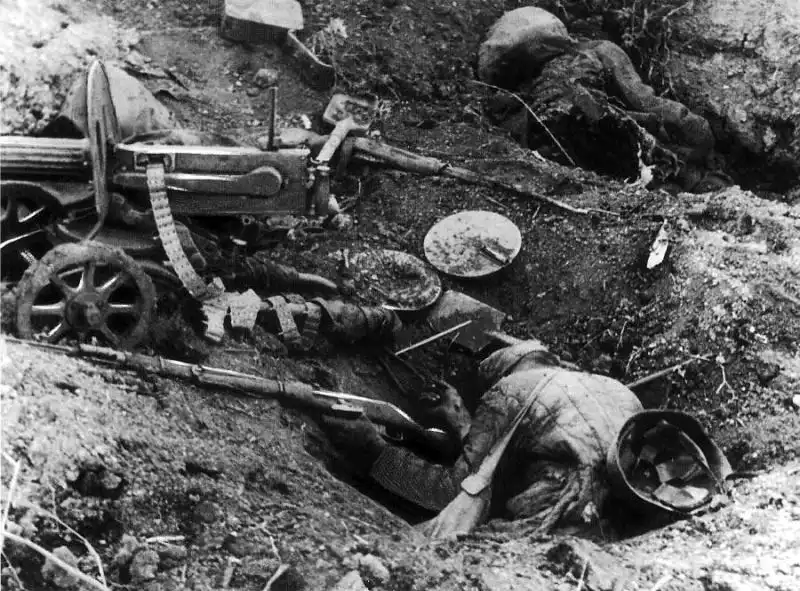
Field Analysis of an Overwhelmed Red Army Machine Gun Position (1942)
This solemn historical photograph from late 1942 captures the aftermath of an intense defensive engagement on the Eastern Front. The image documents a Red Army heavy machine gun crew position established within interconnected individual foxholes (yacheyki) that sustained direct enemy mortar or artillery strikes during close-range defensive combat.
Technical visual details within the cratered field position provide significant historical insight into the weaponry, ammunition supply, and equipment utilized by infantry units during late 1942 fighting.
Weaponry Identification and Defensive Tactical Details
An examination of the military hardware present at the site reveals key operational aspects of the engagement:
- 7.62mm Maxim M1910/30 Heavy Machine Gun: The primary position is anchored by a 7.62×54mmR Maxim heavy machine gun mounted on a Sokolov wheeled carriage. Notably, the rear sight notch is adjusted to its lowest point-blank setting, indicating heavy suppression fire directed at enemy forces approaching at close range.
- DP-27 Light Machine Gun Magazines: Scattered inside the collapsed trenches are circular pan magazines belonging to a Degtyaryov DP-27 light machine gun, indicating that the crew incorporated combined light and heavy machine gun fire to cover their sector.
- Secondary Infantry Arms: Positioned near the trench edge is a Mosin-Nagant M1891/30 bolt-action rifle fitted with a fixed socket bayonet. As belted machine gun ammunition was depleted, crews regularly relied on organic infantry rifles to repel final infantry assaults.
Uniform and Helmet Chronological Identification
Archival analysis of the personal field gear provides clear dating evidence for the photograph:
- SSh-40 Steel Helmet (Six-Rivet Variant): Visible in the trench is an overturned Soviet SSh-40 steel helmet. The internal liner attachment points confirm the six-rivet arrangement (SSh-40), which replaced the earlier three-rivet SSh-39 and saw widespread frontline distribution by 1941–1942, fully consistent with the 1942 dating.
- Field Dress: The soldiers are wearing standard Red Army cold-weather quilted jackets (telogreika) and heavy wool uniforms appropriate for autumn campaign conditions.
📍 Location: Eastern Front, USSR
📅 Date: Autumn 1942
📷 Photographer: Unknown (Red Army / Frontline Photo Archive)
📰 Primary Source: Central Archive of the Russian Ministry of Defense (CAMD) / RGAKFD
Recommended reading:
- Technical design and battlefield use of the 7.62mm Maxim M1910/30 heavy machine gun
- Evolution of Soviet infantry steel helmets: From SSh-36 and SSh-39 to the SSh-40
- Tactical deployment of DP-27 light machine guns in Red Army squad defense
- Infantry trench warfare and field fortifications on the Eastern Front (1941–1942)