Historic March 10, 1945 photograph capturing a severely damaged USAAF B-29 Superfortress (Serial # 44-69703) after making a crash landing on Iwo Jima following a bombing raid over Japan.
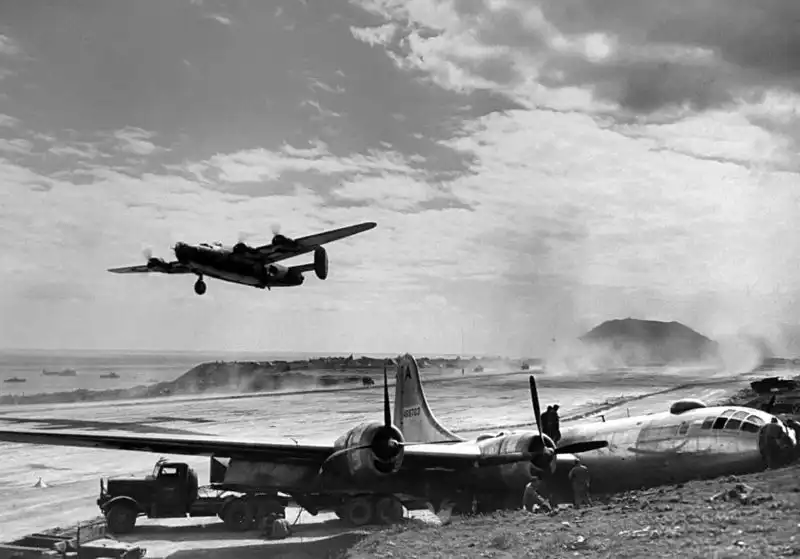
USAAF B-29 Superfortress Emergency Landing on Iwo Jima (March 10, 1945)
This dramatic archival photograph taken on March 10, 1945 shows a damaged United States Army Air Forces (USAAF) Boeing B-29-55-BW Superfortress (Serial # 44-69703) sitting on the tarmac of an emergency airfield on Iwo Jima.
Assigned to the 497th Bombardment Group (19th Bomb Group, tail code A), the heavy four-engine bomber suffered severe damage—losing two of its Wright R-3350 Duplex-Cyclone engines—during a massive low-altitude incendiary strike against industrial targets in Tokyo (or Osaka). Incapable of reaching its home base in the Mariana Islands (Tinian or Saipan), the crew executed an emergency belly landing on the newly secured island of Iwo Jima.
Technical Analysis and Support Vehicles
The photograph illustrates the vital strategic importance of Iwo Jima as a sanctuary for crippled Allied bombers returning from the Japanese mainland:
- B-29 Superfortress Specifications: Powered by four 2,200 hp Wright R-3350 turbo-supercharged radial engines, the B-29 was the most technologically advanced heavy bomber of WWII, featuring pressurized cabins and remote-controlled gun turrets. Losing two engines on one side drastically reduced control and altitude performance over open water.
- Heavy Support Equipment: Positioned adjacent to the damaged aircraft is a US military heavy tractor-trailer truck, identified as a 20-ton 6x4 Federal 604 (or its licensed copy, the REO 28XS), utilized by USAAF service squadrons for heavy salvage, towing fuel tankers, and moving aircraft maintenance trailers.
- Strategic Role of Iwo Jima: The capture of Iwo Jima by the US Marine Corps provided an essential emergency landing strip midway between the Marianas and Tokyo. By the end of WWII, over 2,200 B-29 bombers carrying more than 24,000 crew members landed on the island due to battle damage or fuel exhaustion.
Airfield Salvage and Recovery
Specialized air depot groups stationed on Iwo Jima worked around the clock to strip damaged airframes for spare parts, repair salvageable bombers, and maintain combat readiness for ongoing strategic bombing operations.
📍 Location: Iwo Jima, Volcano Islands, Japan
📅 Date: March 10, 1945
📷 Photographer: Unknown (USAAF Official / US Marine Corps Archive)
📰 Primary Source: US National Archives and Records Administration (NARA) / USAAF Historical Research Agency
Recommended reading:
- Strategic bombing campaign: B-29 operations from the Mariana Islands (1944–1945)
- Island battlefield: The capture and operational role of Iwo Jima airfields
- Aviation mechanics: Wright R-3350 engine vulnerabilities and multi-engine failure recovery
- USAAF ground transport: Federal 604 and REO 28XS heavy tractors in military service