An American anti-aircraft crew operates a water-cooled .50 caliber Colt-Browning machine gun while training in the United States during 1942.
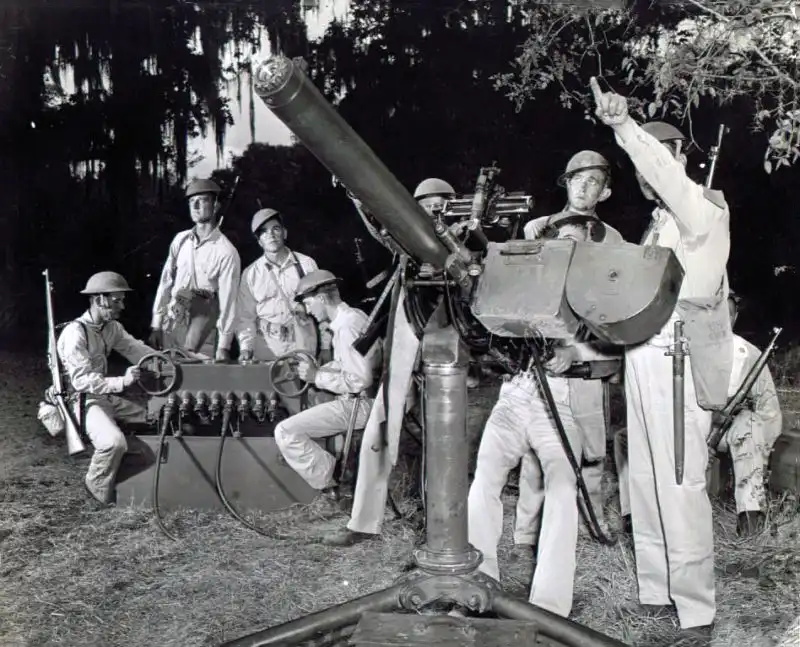
This photograph shows an American anti-aircraft crew manning a water-cooled .50 caliber Colt-Browning heavy machine gun during training in the United States in 1942.
The image captures an interesting transitional period in the rapid expansion of the U.S. Army during the Second World War. Modern fire-control equipment appears alongside military equipment whose origins dated back to the First World War.
The Water-Cooled Colt-Browning:
The anti-aircraft machine gun shown here belongs to the Browning family of heavy machine guns chambered for the powerful .50 BMG (12.7×99 mm) cartridge.
Unlike the later air-cooled Browning M2, this version employs a water-cooled barrel jacket, allowing prolonged periods of sustained fire without overheating.
Although water-cooled heavy machine guns gradually disappeared from front-line service as aircraft became faster and anti-aircraft tactics evolved, they still provided effective defense against low-flying aircraft during the early years of the war.
Fire-Control Equipment:
One of the most interesting features of the photograph appears on the left side of the frame.
Several soldiers are operating an anti-aircraft fire-control system, designed to calculate the necessary lead angle required to engage moving aircraft.
Before the widespread introduction of radar-guided systems, such mechanical computers played a crucial role in improving the effectiveness of anti-aircraft defenses by helping gunners predict the future position of fast-moving targets.
The photograph therefore illustrates not only the weapon itself, but the teamwork required to operate an anti-aircraft battery efficiently.
Equipment from Two Wars:
Another striking detail is the soldiers' equipment.
The crew is still wearing the M1917A1 steel helmet, an improved version of the famous helmet introduced during the First World War. Although officially replaced by the M1 helmet in late 1941, older helmets continued to appear during training and in second-line units as the rapidly expanding U.S. Army gradually re-equipped millions of servicemen.
The crew's personal weapons are Springfield M1903 rifles, another veteran design that remained in widespread service despite the adoption of the semi-automatic M1 Garand. During the early years of the war, many training establishments and support units continued using older rifles because production of newer weapons was prioritized for combat formations.
America's Wartime Mobilization:
Photographs like this demonstrate the enormous scale of American mobilization after the country's entry into the Second World War.
New soldiers had to be trained, thousands of anti-aircraft positions established, and huge quantities of equipment produced in an extraordinarily short period.
As a result, modern technology often coexisted with older but still serviceable equipment until production caught up with demand.
📍 Location: United States
📅 Date: 1942
📷 Photographer: Unknown
Recommended Reading:
- Ian V. Hogg — The Machine Gun
- Gordon L. Rottman — US World War II Anti-Aircraft Artillery
- Chris McNab — Weapons of the US Army in World War II
- Canfield Bruce N. — U.S. Infantry Weapons of World War II
- John Ellis — The World War II Databook
- Steven J. Zaloga — Armored Thunderbolt (for broader U.S. Army equipment and organization)