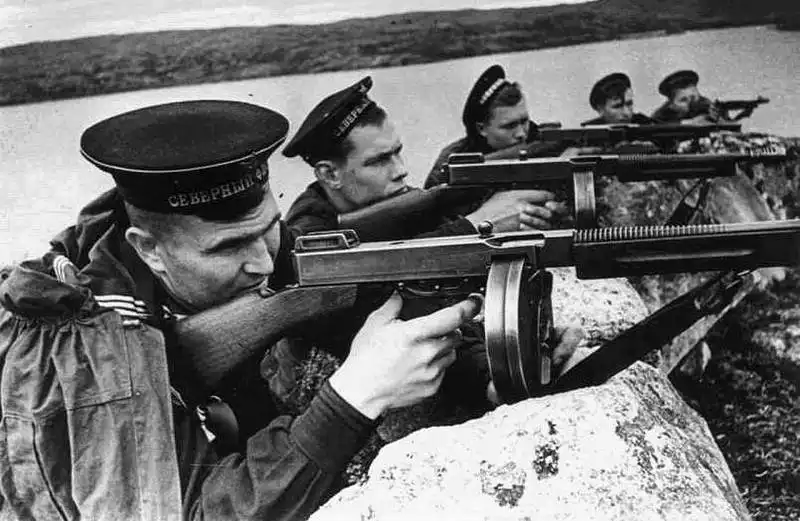
Soviet naval infantry with Thompson submachine guns on the Kola Peninsula, 1942. A rare WWII image showing Lend-Lease weapons in Soviet service.
An Unexpected Combination:
This photograph shows Soviet naval infantry soldiers on the Kola Peninsula in 1942, armed with American Thompson M1928A1 submachine guns.
At first glance, something feels unusual:
👉 Soviet troops
👉 American weapons
👉 Arctic front
And yet — this combination was very real during World War II.
The Weapon – Thompson M1928A1:
The soldiers are armed with the iconic Thompson M1928A1, often associated with:
- American forces
- Law enforcement
- Even gangsters of the 1920s
The weapon was known for:
- High rate of fire
- Reliability
- Heavy weight and strong recoil
Lend-Lease – Lend-Lease Program:
These weapons reached the Soviet Union through the Lend-Lease Program.
Under this program:
- The United States supplied weapons and equipment
- The Soviet Union received trucks, aircraft, food — and firearms
The Thompson was one of many foreign weapons used by Soviet troops.
The Unit – Northern Fleet Marines:
The men in the photograph belong to:
- The 3rd Battalion
- 125th Naval Mountain Rifle Regiment
- Northern Fleet
These were naval infantry, often deployed in:
- Coastal operations
- Arctic conditions
- Difficult terrain
Fighting in the Arctic:
The Kola Peninsula was one of the harshest theaters of war.
Conditions included:
- Extreme cold
- Snow and ice
- Limited infrastructure
Combat here demanded:
👉 Endurance more than anything else
Why the Thompson?
Although the Soviet Union had its own submachine guns (like the PPSh-41), the Thompson was still used because:
- It was available through Lend-Lease
- It provided additional firepower
- It was effective in close combat
However:
- It was heavier than Soviet equivalents
- Used different ammunition
Visual Impact of the Image:
The photograph is striking because of its contrast:
- Soviet uniforms
- American weapons
- Harsh northern landscape
It visually represents the global nature of the war.
Brotherhood of Allies:
This image is a reminder that World War II was not fought in isolation.
Even distant allies were connected through:
- Supply chains
- Shared goals
- Combined efforts
A weapon made in the United States
was now in the hands of Soviet soldiers
fighting on the Arctic front.
Historical Photograph Information:
Location: Kola Peninsula, USSR
Date: 1942
Photographer: Unknown
Sources:
- Newspaper "Krasnoflotets" No. 289 (1412), 09.11.1942
- Newspaper "Severnaya Vakhta" No. 265 (371), 09.11.1942
Recommended Books on Lend-Lease and the Arctic Front:
1. Russia’s War — Richard Overy
2. Arctic Convoys — Richard Woodman
3. The Lend-Lease War — Albert L. Weeks
4. Red Army Infantryman 1941–45 — Gordon L. Rottman