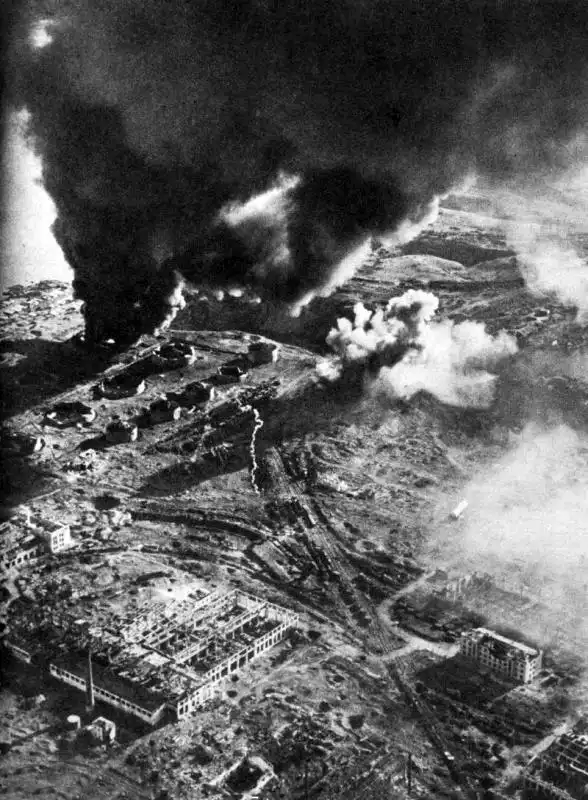
Massive black smoke over Stalingrad after Luftwaffe bombing, 1942. A dramatic WWII image symbolizing destruction and the turning point of the Eastern Front.
A City Consumed by Fire:
This photograph shows enormous black clouds of smoke rising over Stalingrad in the autumn of 1942, following a massive bombing raid by the German Luftwaffe.
The image was taken from a German aircraft, capturing the scale of destruction from above.
What we see is not just smoke —
👉 It is an entire city burning.
The Event – Battle of Stalingrad:
The scene is part of the Battle of Stalingrad, one of the most decisive battles of World War II.
In 1942:
- German forces advanced toward the Volga River
- The Luftwaffe launched massive air raids
- Industrial and civilian areas were heavily bombed
The goal was simple:
👉 Destroy the city before ground forces took it.
The Oil Fires:
The smoke seen in the photograph comes from burning oil storage facilities known as "Neftetanks."
Once ignited, these fuel reserves:
- Produced dense black smoke
- Burned for long periods
- Created massive firestorms
From the air, the city appeared covered by a dark, shifting cloud.
A German Perspective:
A German infantryman from the 3rd Infantry Division later recalled:
"It seemed as if a gigantic black cross hung over the city. We saw in these clouds a symbolic tombstone for Stalin. At that time, we could not imagine that it was a tombstone for the 6th Army."
This quote captures a powerful psychological moment:
- Confidence
- Symbolism
- Misinterpretation of reality
The Illusion of Victory:
At this stage of the battle, German forces believed:
- The city was on the verge of collapse
- Resistance would soon end
But the reality was different:
- Soviet forces continued to resist
- Urban combat intensified
- The battle turned into a prolonged struggle
The Turning Point:
The destruction of Stalingrad did not lead to victory.
Instead:
- The city became a battlefield of ruins
- German forces became overstretched
- Soviet counteroffensives began
Eventually, the German 6th Army was encircled and destroyed.
War from Above:
This image reflects the perspective of aerial warfare:
- Detached
- Strategic
- Devastating
From above, destruction can look almost abstract.
On the ground — it meant death, fire, and chaos.
Symbolism of the Smoke:
The black smoke in the image can be interpreted in different ways:
- As a sign of destruction
- As a symbol of power
- As an omen
In hindsight, it became something else:
👉 A symbol of impending defeat.
The Scale of Destruction:
The bombing of Stalingrad was among the most destructive air assaults of the war.
It resulted in:
- Massive civilian casualties
- Widespread destruction of infrastructure
- Fires that reshaped the battlefield
The city was not erased —
it was transformed into a battlefield.
Historical Photograph Information:
Location: Stalingrad, USSR
Date: Autumn 1942
Photographer: Unknown
Recommended Books on Stalingrad:
1. Stalingrad — Antony Beevor
2. Enemy at the Gates — William Craig
3. The Road to Stalingrad — John Erickson
4. Stalingrad: The Fateful Siege — Antony Beevor