The iconic Pulitzer Prize-winning photograph by Joe Rosenthal capturing U.S. Marines raising the American flag on Mount Suribachi during the Battle of Iwo Jima.
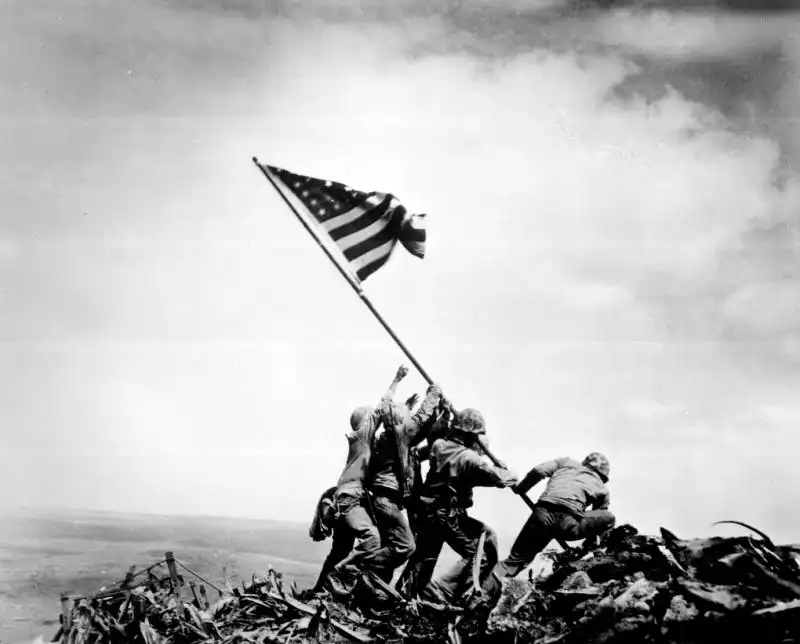
Raising the Flag on Iwo Jima by Joe Rosenthal (February 23, 1945)
Captured by Associated Press photographer Joe Rosenthal on February 23, 1945, this immortal image stands as one of the most widely recognized and reproduced photographs of the Second World War.
The picture freezes the exact moment U.S. Marines raised a second, larger American flag atop Mount Suribachi, dominating the volcanic island of Iwo Jima after days of grueling combat.
The Story Behind the Lens
While the photograph became an instant symbol of American perseverance and military triumph, the tactical reality on the ground was fierce and unforgiving:
- The Flag Replacement: Earlier that morning, a smaller detachment from the 5th Marine Division had successfully scaled Mount Suribachi and raised an initial, smaller U.S. flag. Roughly two hours later, a larger banner was brought up to ensure visibility across the entire island and offshore fleet.
- The Impact on Morale: Secretary of the Navy James Forrestal famously remarked upon seeing the image that it ensured the existence of the Marine Corps for the next five hundred years. The photograph also served to justify the immense cost and strategic necessity of the Marine amphibious doctrine.
- The Ongoing Struggle: Despite the iconic flag-raising, fighting on Iwo Jima raged on for weeks. Remnants of the Japanese garrison launched desperate counterattacks, and the summit faced continued enemy infiltration before the island was finally declared secure.
- Legacy: Joe Rosenthal was awarded the Pulitzer Prize for Photography in 1945, and the composition later inspired the monumental Marine Corps War Memorial in Arlington, Virginia.
📍 Location: Mount Suribachi, Iwo Jima, Japan
📅 Date: February 23, 1945
📷 Photographer: Joe Rosenthal (Associated Press)
📰 Primary Source: U.S. Marine Corps Combat Archives
Recommended reading:
- The Battle of Iwo Jima (1945): Strategic significance and tactical overview
- Joe Rosenthal's Lens: How a single snapshot defined a global conflict
- Monuments of War: From the Suribachi summit to the Arlington memorial