Historical photograph from March 16, 1944, showing U.S. infantrymen of the 37th Infantry Division supported by a Sherman tank advancing through the dense jungles of Bougainville.
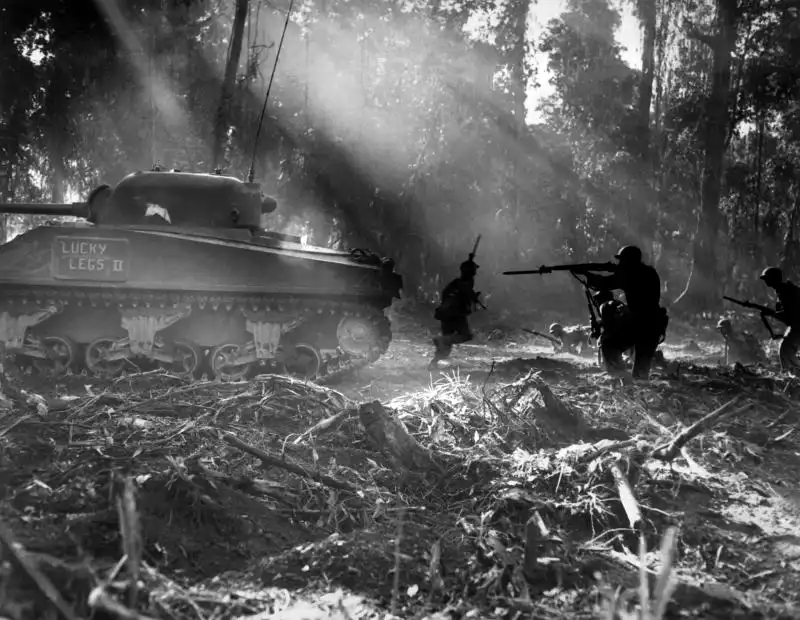
US Infantry and Sherman Tank 'Lucky Legs II' in Action on Bougainville (March 16, 1944)
This evocative archival photograph, sourced from official U.S. military repositories (www.defenseimagery.mil), captures the harsh and claustrophobic realities of jungle warfare in the Pacific Theater on March 16, 1944.
American infantrymen from the 129th Infantry Regiment (37th Infantry Division) are seen advancing through the dense tropical foliage of Bougainville Island closely supported by an M4 Sherman medium tank bearing the nose art name "Lucky Legs II".
The Campaign in the Solomon Islands
Operations on Bougainville presented unique tactical challenges that defined the Pacific island-hopping strategy:
- Jungle Warfare Realities: Following the initial Allied landings that began on November 1, 1943, troops faced grueling conditions involving swampy terrain, torrential rains, and deeply entrenched Japanese defensive positions.
- Armor in the Jungle: Although tanks like the Sherman were initially viewed skeptically for dense jungle operations, they proved invaluable as mobile pillbox-killers, using firepower to clear stubborn machine-gun nests hidden under thick canopy.
- The 37th Division's Role: Units like the 37th "Buckeye" Infantry Division played a pivotal role in securing the perimeter and pushing back fierce Japanese counterattacks during the early months of 1944.
📍 Location: Bougainville Island, Solomon Islands
📅 Date: March 16, 1944
📷 Photographer: Unknown (U.S. Army Signal Corps)
📰 Primary Source: U.S. Defense Imagery Archives (www.defenseimagery.mil)
Recommended reading:
- The Bougainville Campaign (1943–1945): Strategy and jungle combat in the Solomons
- The 37th Infantry Division in the Pacific: From Guadalcanal to Luzon
- Armor Operations in the Pacific Theater: The adaptation of the M4 Sherman for jungle warfare