Historical photograph showing a knocked-out Soviet twin-turret T-26 light tank (1931–1933 pattern) from the 125th Separate Tank Battalion on the cliff edge of Kazachya Bay during the final stand at Sevastopol in summer 1942.
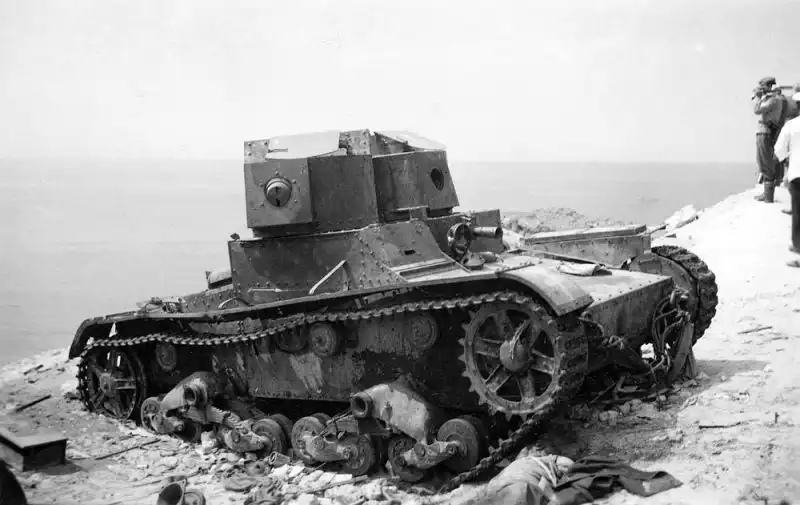
Knocked-Out Soviet Twin-Turret T-26 Tank at Kazachya Bay, Sevastopol (1942)
This poignant archival photograph, taken in the summer of 1942, records the final moments of Soviet armored resistance near Sevastopol. The image depicts a disabled Soviet T-26 light tank (twin-turret variant, produced 1931–1933) belonging to the 125th Separate Tank Battalion, resting directly on the cliff edge above the water line at Kazachya Bay (Cossack Bay).
Positioned at the extreme edge of the Khersones peninsula, the vehicle represents the absolute final line of defense during the concluding phase of the 250-day siege of the fortress city.
Technical Characteristics: Twin-Turret T-26 Model 1931/1933
The early-production T-26 variant featured distinct design and mechanical attributes:
- Twin Independent Turrets: Early T-26 models utilized two fully rotating side-by-side turrets, each armed with a 7.62 mm DT (Degtyaryov Tank) machine gun, designed to sweep infantry trenches with overlapping fields of fire.
- Armor and Chassis Construction: Constructed with riveted armor plating ranging from 6 mm to 15 mm, the tank relied on a licensed modification of the British Vickers 6-Ton suspension system, powered by an air-cooled 8-cylinder gasoline engine.
- Wartime Obsolescence: By 1942, the thin riveted armor of early T-26 models provided no protection against German 3.7 cm PaK 36 or 5 cm PaK 38 anti-tank guns, making their continued tactical employment at Sevastopol an act of extraordinary crew bravery.
The Final Stand of the 125th Separate Tank Battalion
The operational history of the unit during the defense of Sevastopol highlights the fierce nature of the final engagements:
- Command and Operations: Under the command of Major Listobayev and Senior Politruk Osokin, the 125th Separate Tank Battalion provided mobile fire support to infantry formations across the Sevastopol Defense Region until July 3, 1942.
- Last Shoreline Defense: As ammunition supplies were exhausted and coastal defense lines collapsed toward Cape Khersones, surviving tank crews maneuvered their remaining armored vehicles directly to the coastal cliffs of Kazachya Bay to cover the evacuation of wounded personnel and infantry remnants.
- Final Scuttling: Upon expending all machine gun ammunition and suffering total disablement, crews systematically immobilized their vehicles to prevent intact capture by advancing Axis troops.
📍 Location: Kazachya Bay, Sevastopol, Crimea, USSR
📅 Date: Summer 1942
📷 Photographer: Unknown (German Army / Propaganda Company Photo Archive)
📰 Primary Source: Central Archive of the Russian Ministry of Defense (CAMD) / Sevastopol Defense Records
Recommended reading:
- Development history of early Soviet light armor: Twin-turret T-26 tank (1931–1933)
- Combat operations of the 125th Separate Tank Battalion at Sevastopol
- Final engagements on the Khersones Peninsula: Kazachya Bay and Cape Khersones (July 1942)
- Evolution of Red Army armored tactics: From Vickers derivatives to T-34 medium tanks