Historical photograph documenting a knocked-out Soviet T-26 Model 1939 light tank surrounded by Wehrmacht soldiers on a cobbled road during the opening phase of Operation Barbarossa, Summer 1941.
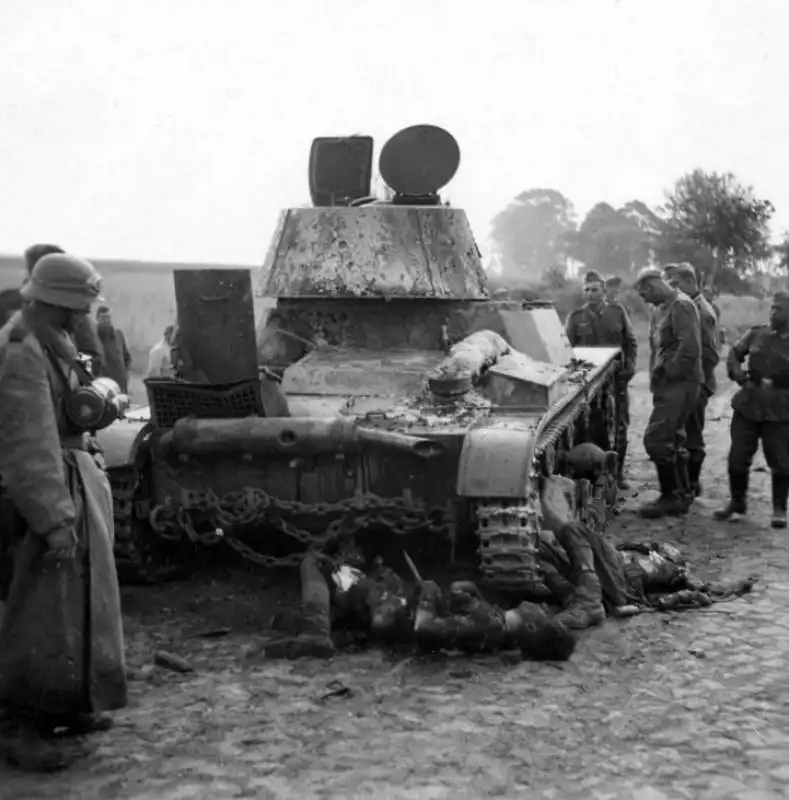
Knocked-Out Soviet T-26 Light Tank on the Eastern Front (Summer 1941):
This stark wartime photograph illustrates the intense armored engagements during the opening weeks of Operation Barbarossa in the summer of 1941. A destroyed Soviet T-26 light tank (Model 1939) lies immobilized on a paved cobblestone road, surrounded by advancing German Wehrmacht infantry and officers examining the wreckage.
The scene reflects the severe attrition suffered by Soviet mechanized corps during border battles across Eastern Poland, Belorussia, and Ukraine in June–July 1941.
Technical Specifications: T-26 Model 1939:
The T-26 was the most numerous light tank in the inventory of the Red Army prior to the German invasion:
- Conical Turret Design: The Model 1939 variant featured a conical turret with sloped armor plates to increase ballistic deflection against light anti-tank projectiles, alongside an updated sub-turret box layout.
- Main Armament: Equipped with a 45mm 20-K tank gun and coaxial 7.62mm DT machine gun. While capable of penetrating contemporary German Panzer II, III, and IV tanks at normal combat ranges, its thin riveted armor (15mm maximum thickness) left it highly vulnerable to German 3.7 cm PaK 36 anti-tank artillery and anti-tank rifles.
- Sub-Turret Hatch Position: Both primary turret hatches are locked fully open, indicating the crew attempted to abandon the burning vehicle after sustaining decisive direct hits to the hull and running gear.
Operational Context of Summer 1941:
In the first months of the war, Red Army armored units faced systemic tactical challenges including supply shortages, lack of air cover, and logistical dislocation:
- Border Tank Battles: Thousands of T-26 and BT-series tanks were lost in counter-offensives such as the Battle of Brody–Dubno and defensive operations along the Western Dvina and Dnieper rivers.
- Combustion Vulnerability: Powered by a gasoline-fueled GAZ-26 engine, the T-26 was prone to rapid catastrophic fires upon armor penetration, presenting high hazards to tank crews under concentrated artillery fire.
- Documentary Evidence: Photographic records taken by German propaganda units (Propagandakompanien) and individual soldiers were widely preserved in personal albums, creating an extensive historical record of early Eastern Front armored combat.
📍 Location: USSR (Eastern Front)
📅 Date: Summer 1941
📷 Photographer: Unknown (Wehrmacht Soldier / German Military Journalist)
📰 Primary Source: WWII Military Archives / Captured Photo Collections
Recommended reading:
- Combat performance and losses of the T-26 light tank during Operation Barbarossa
- Red Army Mechanized Corps organization and tactics in June 1941
- Anti-tank defense doctrines of the German Wehrmacht (1941)
- The Battle of Brody-Dubno and early Eastern Front armored clashes