Historical March 10, 1945 photograph by Kōyō Ishikawa documenting Tokyo residents made homeless sitting among the ashes following the devastating US B-29 firebombing raid.
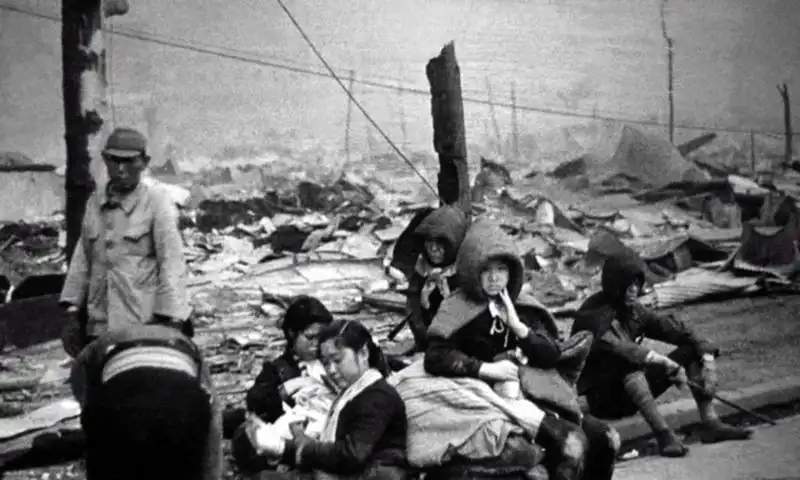
Homeless Civilians Among the Ruins of Tokyo After B-29 Incendiary Raid (March 1945)
This poignant archival photograph taken on March 10, 1945 by Japanese photographer Kōyō Ishikawa captures Tokyo residents left homeless in the immediate aftermath of the devastating nocturnal incendiary bombing raid conducted by American B-29 Superfortress bombers.
Assigned by the Tokyo Metropolitan Police Department to document the aftermath, Ishikawa recorded the human cost of Operation Meetinghouse, which created a massive firestorm that destroyed over 40 square kilometers of dense urban residential areas overnight.
Equipment, Uniforms, and Visual Features
The image offers a stark, realistic depiction of civilian displacement and urban devastation following mass incendiary attacks:
- Civilian Survivors: A group of displaced city residents, primarily women, children, and elderly citizens, huddle on the roadside amidst piles of salvaged household goods and blankets.
- Infant Care in Crisis: In the foreground, a young mother cradles and attends to her infant wrapped tightly in protective cloth, surrounded by family members wearing padded air-raid hoods (Bōkū-zukin).
- Complete Landscape Destruction: The background shows total urban devastation, with traditional wooden structures burned completely to the ground, leaving only charred utility poles, twisted metal roofing, and rubble extending to the horizon.
- Historical Context of the Raid: Carried out by over 300 low-altitude Boeing B-29 bombers dropping M69 incendiary cluster bombs, the March 9–10 raid triggered an uncontrollable firestorm that consumed roughly 330,000 residential homes and displaced over one million inhabitants.
The Legacy of Kōyō Ishikawa's Documentation
Due to strict wartime censorship, public photography of air raid damage was heavily restricted by Japanese authorities. Kōyō Ishikawa was one of the few photographers who systematically preserved a photographic record of the tragedy. Following the Japanese surrender, he refused to hand over his negatives to occupation authorities, hiding them under his house to preserve the historical memory of the event.
📍 Location: Tokyo, Japan
📅 Date: March 10, 1945
📷 Photographer: Kōyō Ishikawa (石川 光陽)
📰 Primary Source: Tokyo Metropolitan Police Department Archive
Recommended reading:
- Air war history: Strategic doctrine behind Operation Meetinghouse and B-29 low-altitude raids
- Wartime photography: The visual record and preserved negatives of Kōyō Ishikawa
- Homefront defense: Air-raid precautions and civilian survival strategies in urban Japan (1944–1945)
- Urban reconstruction: Post-war rebuilding of Tokyo following the 1945 firestorms