Heinz Mertens, the mechanic responsible for maintaining Erich Hartmann's famous Bf 109 fighter, poses for an unusual wartime photograph.
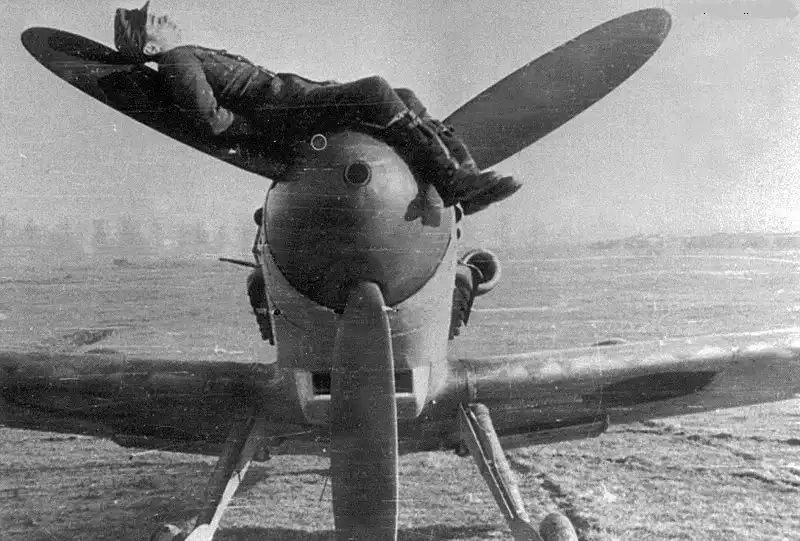
This unusual wartime photograph shows Heinz Mertens, the ground crew mechanic responsible for maintaining the Messerschmitt Bf 109 flown by Germany's highest-scoring fighter ace, Erich Hartmann.
For the sake of a more dramatic photograph, Mertens reclines casually across the aircraft's propeller—a pose that would have been impossible with the engine running but perfectly suitable for a moment of relaxation between missions.
Although fighter aces became famous, photographs such as this remind us that every successful combat pilot relied on a skilled team of mechanics working tirelessly behind the scenes.
The Men Behind Every Fighter:
A Luftwaffe mechanic's responsibilities extended far beyond routine maintenance.
Before every sortie, ground crews inspected the aircraft, serviced the engine, replenished fuel and ammunition, repaired combat damage, and ensured that every system functioned correctly.
On the Eastern Front, where airfields were often little more than muddy or snow-covered clearings, maintenance crews worked under extremely difficult conditions. They frequently had to repair aircraft in freezing temperatures, under camouflage nets, and sometimes within range of enemy artillery or air attack.
The combat effectiveness of Germany's fighter force depended as much on these mechanics as on the pilots themselves.
Supporting Erich Hartmann:
Heinz Mertens served as the mechanic responsible for the aircraft of Erich Hartmann, the Luftwaffe's most successful fighter pilot.
Hartmann was officially credited with 352 aerial victories, making him the highest-scoring fighter ace in aviation history.
Keeping a frontline fighter operational after hundreds of combat missions demanded exceptional technical skill. Every successful sortie required countless hours of maintenance, inspection, adjustment, and repair performed by experienced ground personnel.
For many pilots, a trusted mechanic became almost as important as a wingman.
Flight Boots Designed for Survival:
One interesting detail visible in the photograph is Mertens' footwear.
He is wearing insulated Luftwaffe flight boots, lined for cold-weather operations. Unlike ordinary military boots, these featured straps around the upper section to prevent them from slipping off during emergency parachute jumps.
The design reflected the practical requirements of military aviation, where pilots and aircrew might have to abandon their aircraft at high altitude in freezing conditions.
Although intended primarily for flying personnel, such boots were also occasionally worn by ground crew members working around aircraft during winter operations.
A Rare Human Moment:
Unlike many wartime photographs showing combat or destruction, this image captures a relaxed and almost playful moment.
The mechanic's comfortable pose on the propeller contrasts sharply with the dangerous work that surrounded him every day. Within hours, the same aircraft might again be taking off for another combat mission.
The photograph serves as a reminder that behind every famous fighter ace stood an entire team of specialists whose work rarely attracted public attention but proved essential to keeping aircraft in the air.
📍 Location: Unknown
📅 Date: Unknown
📷 Photographer: Unknown
Recommended Reading:
- Raymond F. Toliver & Trevor J. Constable — The Blond Knight of Germany
- Raymond F. Toliver & Trevor J. Constable — Horrido! Fighter Aces of the Luftwaffe
- Christer Bergström — The Battle of Kursk: The Air Battle
- Donald L. Caldwell — JG 52: The Experten
- Alfred Price — The Last Year of the Luftwaffe
- Richard Suchenwirth — Command and Leadership in the German Air Force