Historical photograph from August 12, 1943, depicting Luftwaffe pilot Hans-Ulrich Rudel and radio operator Emil Oechsler celebrating milestone combat sorties in front of a Junkers Ju 87 G-2.
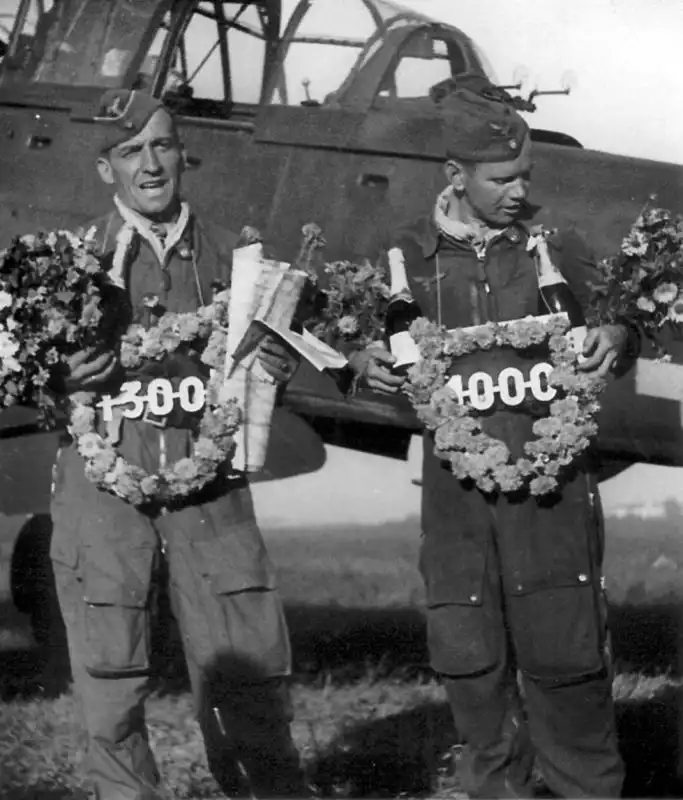
Hans-Ulrich Rudel's 1,300th Sortie Ceremony (August 1943)
This archival photograph, captured on August 12, 1943, documents a battlefield ceremony on the Eastern Front celebrating combat milestones for personnel of III./Sturzkampfgeschwader 2 (StG 2). On the left, Hauptmann Hans-Ulrich Rudel holds a floral wreath marked "1300" denoting his 1,300th combat mission, while his gunner/radio operator, Oberfeldwebel Emil Oechsler, holds a wreath commemorating his 1,000th sortie.
Positioned in the background is a specialized anti-tank variant of the legendary dive bomber, the Junkers Ju 87 G-2 "Kanonenvogel", equipped with twin 37 mm BK 3,7 autocannons.
Official Luftwaffe Claims vs. Historical Re-Analysis
Rudel's official wartime record remains one of the most widely cited and debated service statistics in modern military aviation history:
- Wartime Claims Record: Official Reich Air Ministry (RLM) accounts credited Rudel with an unprecedented 2,530 combat sorties, claiming the destruction of 519 Soviet tanks, over 800 soft-skinned vehicles, 150 artillery pieces, 4 armored trains, and several warships including the damaged Soviet battleship Marat.
- Historiographical Re-Evaluation: Modern military historians and archival researchers frequently scrutinize these figures. Discrepancies between claimed air-to-ground victories and verified Red Army armor losses highlight the significant influence of Third Reich wartime propaganda (such as Ministry of Public Enlightenment press releases) and the inherent difficulty of confirming combat damage from high-speed aircraft during intense engagements.
- Operational Pace: Achieving thousands of combat sorties required extreme operational density, often consisting of short-range shuttle strikes against advancing Soviet armor columns during major encirclement operations such as the Battle of Kursk.
The Ju 87 G-2 Tank-Buster Concept
By mid-1943, the aging Ju 87 design was adapted for specialized low-altitude anti-armor roles:
- Armament System: Two underwing 37 mm Bordkanone 3,7 (BK 3,7) autocannons firing tungsten-core armor-piercing ammunition were used to target the vulnerable top and rear engine armor of Soviet T-34 and KV-series tanks.
- Tactical Limitations: Heavy underwing cannons severely compromised the aircraft's maneuverability and airspeed, making these "tank-busters" exceptionally vulnerable to Soviet fighter interception and ground-based anti-aircraft fire.
📍 Location: USSR, Eastern Front
📅 Date: August 12, 1943
📷 Photographer: Unknown (Luftwaffe PK War Correspondent)
📰 Primary Source: German Federal Archives (Bundesarchiv) / StG 2 Operational Records
Recommended reading:
- Technical development of the Junkers Ju 87 G-2 Kanonenvogel
- Verification methodologies for air-to-ground claims in WWII aviation
- Combat operations of Sturzkampfgeschwader 2 during the Battle of Kursk
- Analysis of Red Army armored losses versus Luftwaffe tactical claims on the Eastern Front