German StuG III Ausf. B assault gun photographed on the move along a dusty road in the USSR during the summer of 1942, with technical and historical context.
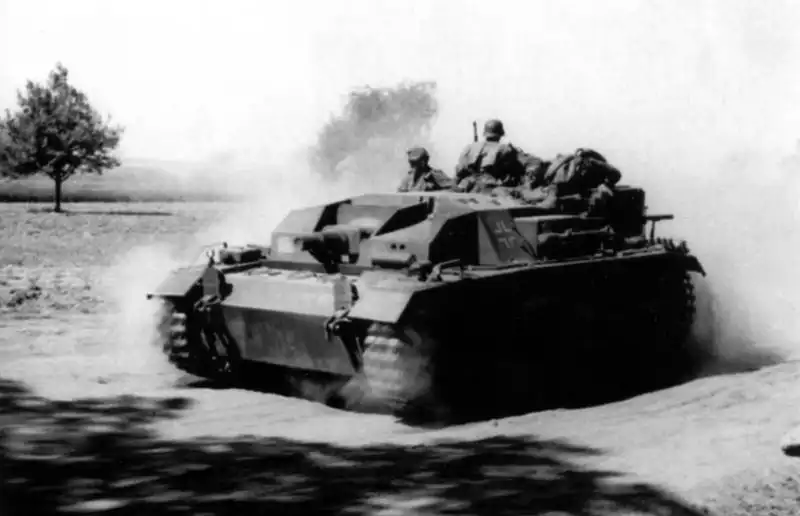
German StuG III Ausf. B on the March (Summer 1942)
This wartime photograph shows a German StuG III Ausf. B assault gun moving along a dusty road in the USSR during the summer of 1942. Unlike images of destroyed vehicles or battlefield positions, this photograph captures an armored vehicle during active movement, reflecting the pace and scale of operations on the Eastern Front.
The StuG III Ausf. B was built on the Panzer III chassis and armed with a short-barreled 75 mm gun designed primarily for infantry support. Its compact appearance led to the informal nickname "cigarette butt" among soldiers because of the short length of its gun barrel.
Photo Information
- Location: USSR
- Date: Summer 1942
What the Photo Shows
The image captures a StuG III Ausf. B in motion, raising clouds of dust as it travels along a rural road. The photograph highlights several important aspects of armored warfare:
- The mobility of German armored formations
- The enormous distances covered during campaigns in the Soviet Union
- The importance of road movements and logistics in modern warfare
Such scenes were common in 1942, when German forces conducted large-scale operations deep inside Soviet territory and armored units frequently moved hundreds of kilometers between combat zones.
StuG III Ausf. B: Design and Purpose
The Sturmgeschütz III was designed as an assault gun rather than a traditional tank. Instead of a rotating turret, it used a fixed armored superstructure with the gun mounted directly into the hull. This design allowed a lower profile, simpler construction, and effective direct fire support for infantry units.
Key Characteristics of the StuG III Ausf. B
- Chassis: Based on the Panzer III medium tank design
- Armament: Short-barreled 75 mm StuK 37 L/24 gun
- Role: Infantry support and destruction of field fortifications
- Silhouette: Low profile compared with turreted tanks
- Production: Approximately 320 vehicles of the Ausf. B variant
The short-barreled gun was effective against:
- Field fortifications
- Infantry positions
- Light armored vehicles
However, the StuG III Ausf. B was not designed primarily for long-range tank combat against heavily armored enemy vehicles.
The "Cigarette Butt" Gun
The short 75 mm gun of early StuG III variants received the informal nickname "cigarette butt" because of its short and thick appearance. Despite the nickname, the weapon was highly effective for the role it was designed to perform.
- Destroying bunkers and defensive positions
- Supporting infantry attacks in villages and fortified areas
- Providing mobile direct-fire support
Later StuG III versions received longer guns and became increasingly effective against enemy tanks, transforming the vehicle into one of Germany's most important armored fighting systems.
Combat Use in 1942
During the summer and autumn of 1942, StuG III assault guns were actively used across the Eastern Front. Early variants such as the Ausf. B remained in service and participated in major German operations, including the advance toward the southern Soviet territories.
The strengths of the StuG III included:
- Good frontal protection for an assault vehicle
- Low silhouette and easier concealment
- Reliable mechanical components based on the Panzer III chassis
Its limitations included:
- Limited effectiveness against newer enemy tanks
- Restricted gun movement due to the fixed mounting
- Dependence on tactical positioning
Armored Columns and the Eastern Front
Long-distance movement was one of the defining features of warfare in the Soviet Union. Armored vehicles such as the StuG III often had to:
- Travel hundreds of kilometers across poor roads
- Operate in dust, mud, and extreme weather conditions
- Remain functional far from repair and supply facilities
This photograph reflects an important reality of armored warfare: victory depended not only on weapons and armor, but also on mobility, maintenance, fuel supplies, and logistics.
Historical Significance of the Image
This photograph is valuable because it shows an assault gun in operational conditions rather than as a battlefield wreck or display vehicle.
The image documents:
- A StuG III Ausf. B during active movement on the Eastern Front
- The environment of German armored operations in 1942
- The continued use of early assault gun variants
- The everyday reality of mechanized warfare beyond the battlefield itself
It captures a moment when German armored formations were still advancing across vast Soviet territories and relying heavily on mobility and operational tempo.
Conclusion
The photograph of a StuG III Ausf. B on the march during the summer of 1942 illustrates the mobile and demanding nature of the Eastern Front campaign. As one of the early versions of Germany's famous assault gun series, the vehicle represents an important stage in the development of armored warfare and the evolution of the Sturmgeschütz concept.
Recommended Literature
- Walter J. Spielberger — Sturmgeschütz: The Development and Employment of the German Assault Gun
- Steven J. Zaloga — StuG III Assault Gun 1940–1942
- Thomas L. Jentz — Panzer Truppen: German Armored Troops 1933–1942
- David M. Glantz — Barbarossa Derailed: The Battle for Smolensk 1941