German Sd.Kfz. 10 light half-track fitted with a 2 cm Flak 30 anti-aircraft gun in the USSR during summer 1942, showing mobile air defense adaptation.
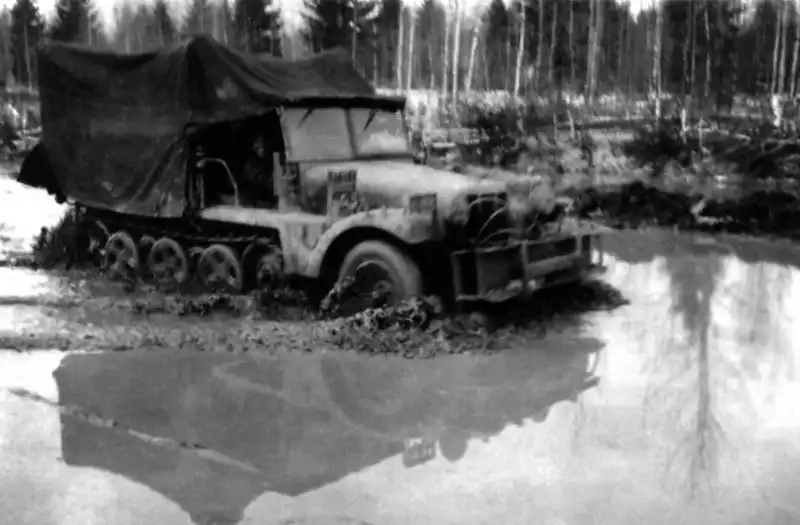
German Sd.Kfz. 10 with Flak 30 AA Gun (Summer 1942)
This wartime photograph shows a German self-propelled anti-aircraft gun mounted on the chassis of a Sd.Kfz. 10 half-track artillery tractor, operating on the Eastern Front in the USSR in the summer of 1942. In the rear cargo bed is installed a 2 cm Flak 30 anti-aircraft gun, while a visible counterweight is mounted on the front of the cab, and rifle holders are attached to the fenders.
The vehicle represents a mobile air-defense solution adapted to fast-moving frontline conditions.
Photo Information
- Location: USSR
- Date: Summer 1942
- Photographer: Unknown
What the Photo Shows
The image depicts:
- A Sd.Kfz. 10 light half-track tractor
- A mounted 2 cm Flak 30 anti-aircraft gun
- Counterweight installed at the front for balance
- Infantry equipment including rifle holders
This configuration transformed a light artillery tractor into a mobile anti-aircraft platform, capable of accompanying advancing units and protecting them from low-flying aircraft.
Sd.Kfz. 10: Light Half-Track Tractor
The Sd.Kfz. 10 (Sonderkraftfahrzeug 10) was classified as a leichter Zugkraftwagen (light prime mover) with a 1-ton towing capacity.
Key Characteristics
- Light half-track design (wheels front, tracks rear)
- Designed to tow light artillery
- High mobility over rough terrain
- Open cargo area adaptable for various roles
Although originally intended for towing, the chassis proved versatile enough for conversions such as this anti-aircraft configuration.
The Flak 30 Anti-Aircraft Gun
The 2 cm Flak 30 was a 20 mm automatic anti-aircraft gun widely used by German forces.
Main Features
- High rate of fire
- Effective against low-flying aircraft
- Could also be used against light ground targets
- Relatively lightweight and mobile
Mounted on a half-track, it allowed rapid repositioning and direct support for mobile operations.
Balance and Field Modifications
The installation of a Flak gun in the rear altered the vehicle’s weight distribution. To compensate, a counterweight was added to the front of the cab. This practical modification highlights:
- Field adaptation to mechanical realities
- The importance of stability when firing
- The improvisational nature of many frontline conversions
Such details demonstrate that not all combat vehicles were factory-standard; many were adapted to immediate tactical needs.
German Half-Track Towing Classes
German prime movers of the Second World War were categorized by towing capacity:
- Sd.Kfz. 6 — 5-ton light tractor
- Sd.Kfz. 7 — 8-ton medium tractor
- Sd.Kfz. 8 — 12-ton heavy tractor
- Sd.Kfz. 9 — 18-ton heavy tractor
- Sd.Kfz. 10 — 1-ton light tractor
- Sd.Kfz. 11 — 3-ton light tractor
The Sd.Kfz. 10 belonged to the lightest class but proved adaptable beyond its original purpose.
Eastern Front, Summer 1942
In 1942, operations on the Eastern Front required:
- Mobile air defense against Soviet aviation
- Protection of supply columns and advancing infantry
- Rapid redeployment along long and vulnerable routes
Self-propelled anti-aircraft vehicles like this one were essential in maintaining operational mobility under aerial threat.
Strengths and Limitations
Strengths:
- Mobility and flexibility
- Quick deployment
- Dual role against air and light ground targets
Limitations:
- Light protection for crew
- Vulnerability to artillery and heavy fire
- Limited ammunition capacity
This vehicle was effective as a mobile support platform, but not suited for prolonged frontline engagements.
Why This Photograph Matters
This image is important because it shows:
- A practical adaptation of a light half-track into an AA platform
- The integration of mobility and air defense
- The logistical and tactical flexibility of German units
- A realistic snapshot of Eastern Front operations in 1942
It highlights how warfare required constant technical improvisation.
Conclusion
The photograph of a Sd.Kfz. 10 equipped with a Flak 30 in the summer of 1942 captures the mobile and adaptive nature of warfare on the Eastern Front. Originally a light artillery tractor, the vehicle became a self-propelled anti-aircraft gun, reflecting the need for flexible protection against air threats in fast-moving operations.
It stands as an example of how even light support vehicles were transformed into combat systems in response to the evolving demands of modern war.