Historical analysis of a 1942 photograph showing a downed Junkers Ju 87B "Stuka" from Stukageschwader 2 "Immelmann" guarded by German troops after a forced landing in the USSR.
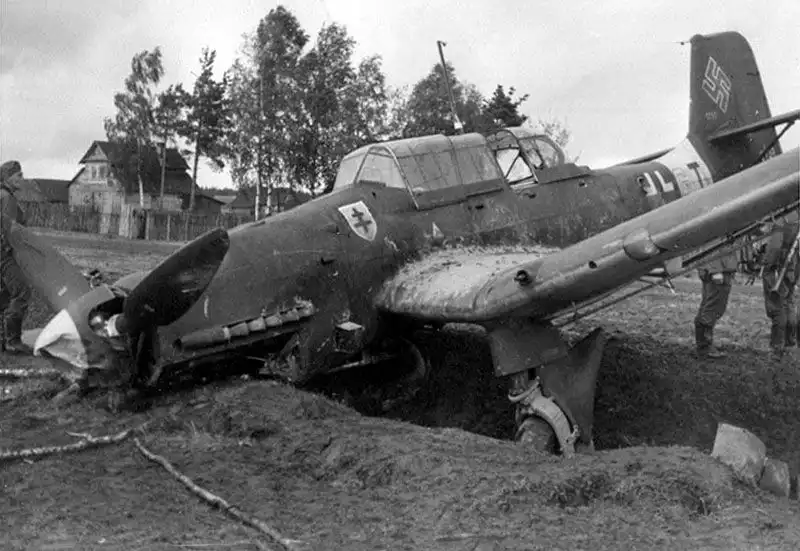
This archival photograph from 1942 captures a damaged German Junkers Ju 87B "Stuka" dive bomber resting in a field ditch on the outskirts of a Soviet village following an emergency forced landing on the Eastern Front.
Guarded by armed German infantrymen, the aircraft displays characteristic airframe damage resulting from a hard belly landing caused by engine malfunction or enemy ground fire.
Technical Features and Unit Markings
The photograph provides detailed visual evidence confirming the exact variant and squadron affiliation of the downed dive bomber:
- Variant Identification (Ju 87B "Berta"): The airframe exhibits features of the Ju 87B series, including the reshaped engine cowling housing the Junkers Jumo 211 liquid-cooled engine and winged radiator baths.
- Armament Details: Wing-mounted armament consists of two internal 7.92 mm MG 17 machine guns firing outside the propeller arc. Under standard combat loads, the Ju 87B carried a 500 kg bomb on a swinging ventral crutch, though maximum short-range overload configurations allowed carrying a 1,000 kg bomb without a rear gunner.
- Squadron Emblem (3./St.G 2): Prominently painted on the forward engine cowling is the shield bearing a double cross (Cross of Lorraine / St. Stephen's Cross), the official unit insignia of the 3rd Squadron of Stukageschwader 2 "Immelmann" (3./St.G 2).
- Propeller and Landing Gear Damage: Both wooden propeller blades are bent, indicating the engine was still rotating upon impact. The main landing gear strut has collapsed into an earth trench alongside the fuselage.
Luftwaffe Operations on the Eastern Front (1942)
During the 1942 campaigns in Southern Russia and the Central sector, Ju 87B and upgraded Ju 87D dive bombers of Stukageschwader 2 provided close air support to advancing Wehrmacht armored columns. Operating from primitive forward airstrips, Stuka units frequently suffered forced landings in rural areas due to intense Soviet light anti-aircraft fire and harsh field operating conditions.
📍 Location: USSR (Eastern Front)
📅 Date: 1942
📷 Photographer: Unknown (Wehrmacht / Luftwaffe War Correspondent)
📰 Primary Source: WWII Military Aviation Historical Archives
Recommended reading:
- Stukageschwader 2 "Immelmann": Operational history and unit insignia on the Eastern Front
- Junkers Ju 87B Specifications: Engine design, bomb load limits, and wing armament
- Luftwaffe Field Maintenance: Recovery and repair procedure (Bergezug) for downed aircraft in Russia
- Close Air Support Tactics: The role of Stuka dive bombers in 1942 Wehrmacht offensives