Color WWII photograph of stylish Parisian women posing in the Luxembourg Gardens during the German occupation of Paris in 1942.
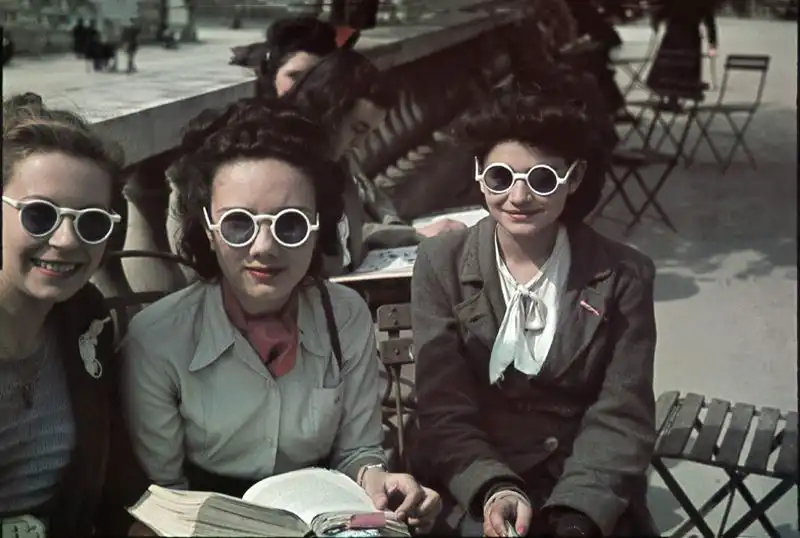
Elegance in Occupied Paris:
This striking color photograph shows three fashionable young Parisian women posing in the German occupation of Paris in May 1942.
At first glance, nothing in the image suggests war:
- Stylish dresses
- Calm weather
- Relaxed expressions
- A peaceful public park
Yet this photograph was taken in a city occupied by Nazi Germany during World War II.
The Setting – Luxembourg Gardens:
The women stand inside the famous Luxembourg Gardens, one of the most elegant public parks in Paris.
Created in the 17th century, the gardens became:
- A popular meeting place
- A center of Parisian social life
- A symbol of leisure and culture
Even during wartime, Parisians continued visiting the park.
Occupied Paris Was Different:
The German occupation of France differed greatly from conditions in Eastern Europe.
In cities like:
- Warsaw
- Minsk
- Smolensk
- Stalingrad
occupation often meant:
- Mass destruction
- Starvation
- Terror campaigns
- Open brutality
Paris experienced occupation differently.
The Germans viewed the French capital as:
- A prestigious European city
- A political prize
- A valuable economic center
As a result, much of everyday urban life outwardly continued.
Life Continued — But Under Control:
Photographs like this sometimes create the impression that Parisians lived comfortably during the occupation.
Reality was more complicated.
Behind scenes of fashion and cafés existed:
- Rationing
- Curfews
- German censorship
- Political repression
- Arrests and deportations
People adapted because survival required adaptation.
Fashion During Wartime:
One fascinating aspect of occupied Paris was the survival of fashion culture.
Even during wartime shortages:
- Tailors continued working
- Women repaired and reused clothing
- Paris maintained its reputation for style
Fashion became:
👉 A form of psychological resistance
👉 A way to preserve dignity and normal life
The Photographer – André Zucca:
The photograph was taken by André Zucca, famous for his rare color images of occupied Paris.
His photographs remain controversial because they often show:
- Sunny streets
- Fashionable civilians
- Busy cafés
- Peaceful city life
rather than the darker realities of occupation.
Color Images Change Perception:
Black-and-white wartime photographs feel distant to modern viewers.
But color photography creates immediacy.
The women in this image suddenly appear:
- Real
- Modern
- Familiar
The war no longer feels like ancient history.
Parisian Society Under Occupation:
During the occupation, Parisian society became deeply divided:
Some people:
- Collaborated with German authorities
- Continued business as usual
Others:
- Joined the Resistance
- Hid fugitives
- Distributed underground newspapers
And many simply tried to survive quietly.
The Illusion of Peace:
This image perfectly demonstrates one of the strangest truths of World War II:
👉 War does not always look like war
Even while millions died across Europe:
- Parks remained open
- Couples walked through gardens
- Fashion survived
- Daily routines continued
That contradiction makes photographs like this historically powerful.
Paris in Spring 1942:
May 1942 was a tense period in occupied France.
Only weeks later:
- Anti-Jewish measures intensified
- Deportations accelerated
- Resistance activity increased
Yet in this moment, the city still projected elegance and calm.
Historical Photograph Information:
Location: Paris, France
Date: May 1942
Photographer: André Zucca
Recommended Books on Occupied Paris:
1. France Under the Germans — Julian Jackson
2. Paris After the Liberation — Antony Beevor & Artemis Cooper
3. The Collapse of the Third Republic — William Shirer
4. Suite Française — Irène Némirovsky