Photo of the family of Soviet hero Sergeant Nikolai Khitrykh visiting his artillery brigade after his death near Orel in 1943, with historical context and biography.
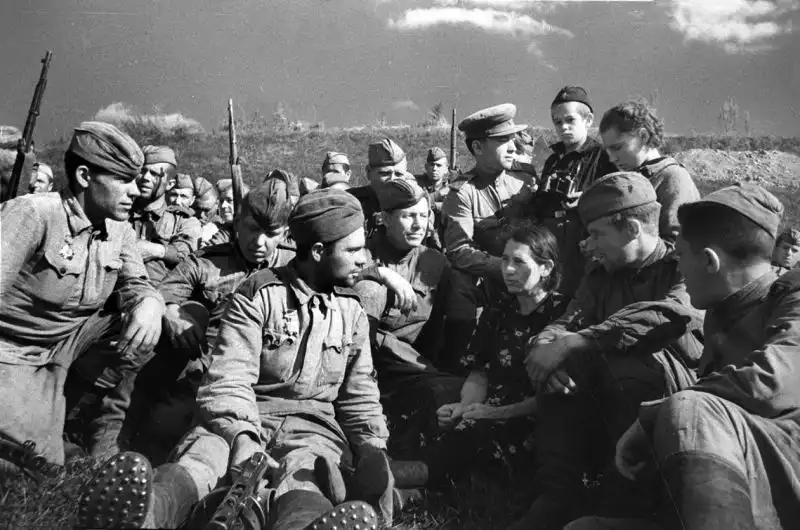
Family Visits the Unit of Fallen Soviet Hero Sergeant Nikolai Khitrykh (1943)
Unlike many wartime photographs that focus on weapons or combat, this image tells a deeply personal story. It shows the family of Sergeant Nikolai Mikhailovich Khitrykh visiting the Guards Order of Lenin Anti-Tank Artillery Brigade where he had served before being killed in action near Orel in 1943. The meeting brought together grieving relatives and the soldiers who had fought beside him, preserving the memory of his final battle.
Photo Information
- Location: Kursk region, USSR
- Date: 1943
- Photographer: Natalia Bode
The Final Battle of Sergeant Khitrykh
According to Soviet wartime records, Khitrykh distinguished himself during fierce fighting by continuing to serve his anti-tank gun after its commander had been killed. Taking charge of the crew, he helped repel repeated German attacks and was credited with destroying six German tanks, including three Tiger heavy tanks, before being mortally wounded by shell fragments.
His conduct became an example of determination under extreme battlefield conditions, illustrating the vital role played by Soviet anti-tank artillery during the campaigns of 1943.
The Visit of His Family
After the battle, Khitrykh's wife Anna Nikolaevna and their children, Volodya and Zoya, visited the brigade in which he had served. Such meetings were uncommon but deeply meaningful. They allowed relatives to meet the men who had fought beside their loved one and to hear firsthand accounts of his courage.
The photograph therefore records not only grief, but also the bond between soldiers and the families who shared the sacrifices of war.
Historical Context
The events unfolded during the decisive fighting around Orel and Kursk in 1943. Following the victory at Stalingrad, the Red Army was steadily seizing the strategic initiative. Anti-tank artillery formations were instrumental in breaking German armored attacks before Soviet forces launched major counteroffensives that pushed the Wehrmacht westward.
Legacy
Although Nikolai Khitrykh did not live to see victory, his name survived through wartime reports, military decorations, and photographs such as this one. Rather than depicting the battle itself, the image preserves something equally valuable—the enduring connection between a fallen soldier, his comrades, and the family he left behind.
Conclusion
More than eighty years later, this photograph remains a moving reminder that military history is not only the story of battles and weapons. It is also the story of families, sacrifice, remembrance, and the people whose courage shaped the outcome of the war.
Recommended Reading
- David M. Glantz. The Battle of Kursk.
- David M. Glantz & Jonathan House. When Titans Clashed.
- John Erickson. The Road to Berlin.
- Chris Bellamy. Absolute War.