Aerial photograph taken on September 3, 1944, capturing a precision bombing strike by American B-17 and B-24 bombers against the Prince Peter II railway bridge in Belgrade.
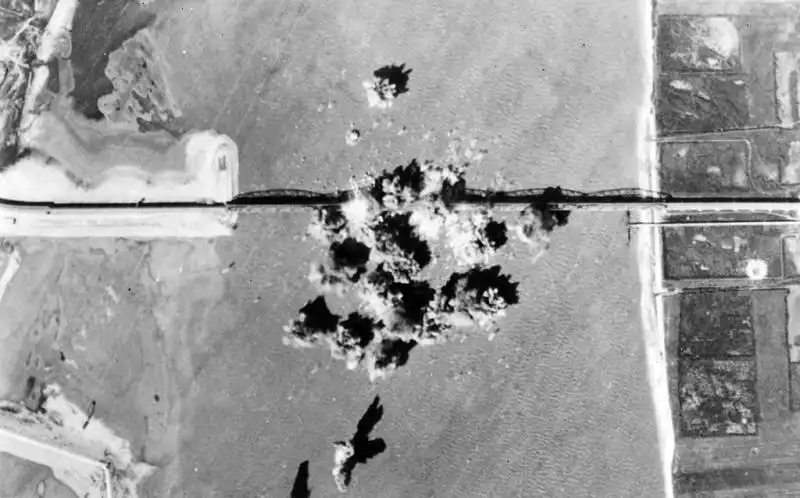
USAAF Bombing Strike on the Prince Peter II Bridge in Belgrade (September 3, 1944)
This striking strike-analysis aerial photograph, taken on September 3, 1944, records a precision raid executed by heavy bombers of the United States Army Air Forces (USAAF) against the Prince Peter II Bridge (Pančevo Bridge) spanning the Danube River in Belgrade Yugoslavia. The raid formed a critical element of Operation Ratweek, a joint Allied strategic interdiction effort designed to paralyze German troop movements across the Balkans.
The photo illustrates the exact moment of impact as heavy high-explosive bomb clusters strike the central steel truss spans and stone piers over the river.
Tactical Precision and 97% Target Accuracy
In the doctrine of World War II unguided high-altitude strategic bombing, destroying narrow linear targets like bridges was notoriously difficult, typically requiring hundreds of sorties. However, the September 3 raid on Belgrade became legendary within the USAAF Fifteenth Air Force:
- Benchmark Accuracy: Post-strike aerial reconnaissance and bomb-plot analysis confirmed that 97% of dropped ordnance fell directly within the target perimeter, creating multiple structural collapses along the rail and roadway spans.
- Bombing Instrumentation: The raid utilized heavy B-17 Flying Fortress and B-24 Liberator formations flying at high altitude, synchronized through advanced Norden bombsights and specialized lead-bombardier visual tracking techniques.
- Interdiction Impact: Destroying the bridge severed the primary railway bottleneck connecting Belgrade to Pančevo and Romania, stranding thousands of retreating Wehrmacht units and heavy equipment attempting to withdraw toward Germany and Austria.
Strategic Role in the Balkan Theater (1944)
The destruction of Yugoslavian infrastructure played a vital role in accelerating the liberation of Southeastern Europe:
- Denying Evacuation Routes: Following Romania's switch to the Allies in August 1944, German Army Group E was forced into a desperate retreat from Greece and the Balkans. Disrupting Danube bridge crossings funneled Axis forces into choke points where they were intercepted by Yugoslav Partisans and advancing Red Army formations.
- Prelude to the Belgrade Offensive: Clearing the Danube crossings prepared the operational setting for the Soviet-Yugoslav Belgrade Offensive in October 1944, which permanently freed the capital from Axis occupation.
📍 Location: Belgrade, Kingdom of Yugoslavia
📅 Date: September 3, 1944
📷 Photographer: Unknown (USAAF Reconnaissance Camera / 15th Air Force Strike Photo)
📰 Primary Source: National Archives and Records Administration (NARA) / USAAF Strategic Bombing Survey
Recommended reading:
- Operation Ratweek and Allied air interdiction tactics in the Balkans (1944)
- Operational deployment of the Norden bombsight on B-17 and B-24 bombers
- Strategic retreat of German Army Group E from Greece and Yugoslavia
- The Belgrade Offensive (October 1944) and Red Army joint operations