Archival summer 1941 photograph depicting a burning Red Army BT-7 fast light tank on a rural road with open hatches, indicating the crew successfully evacuated during the early days of Operation Barbarossa.
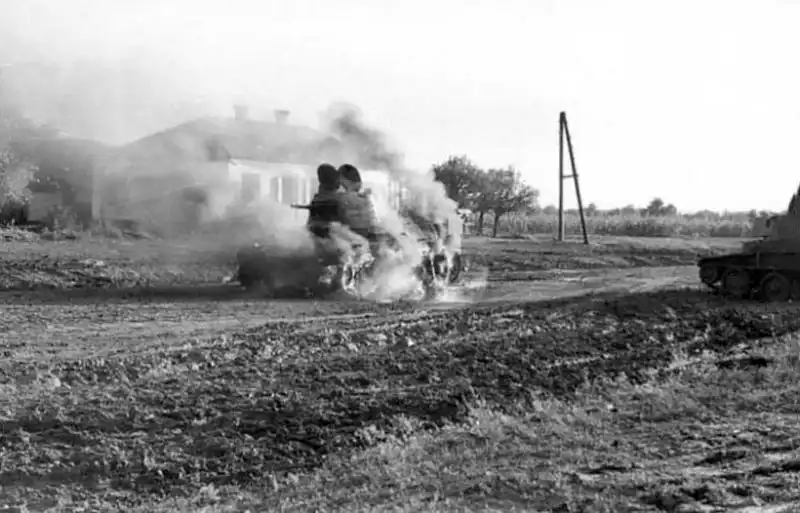
Burning Red Army BT-7 Fast Tank on the Eastern Front (Summer 1941)
This dramatic archival photograph from the summer of 1941 captures a Soviet BT-7 fast light tank engulfed in flames following a short-range combat engagement during the opening stages of Axis invasion of the Soviet Union (Operation Barbarossa). The armored vehicle sits disabled on a rural dirt road in front of a village house, while the track and hull of a second BT-7 light tank are visible on the right edge of the frame.
Crucially, the main turret hatches are thrown completely open, providing evidence that the tank crew managed to bail out before fire consumed the fighting compartment and ammunition stores.
Technical Characteristics of the BT-7 Light Tank
An examination of the burning armored vehicle highlights several key technical features of the Soviet Red Army's primary fast tank model during the 1930s and early 1940s:
- Conical Turret Design (Model 1937): The distinctive sloped conical turret layout houses a 45mm 20-K tank gun and a coaxial 7.62mm DT machine gun, offering improved ballistic protection compared to earlier cylindrical turret variants.
- Christie Suspension System: Built on the convertible Christie suspension principle, the BT-7 was designed for high-speed road mobility on rubber-tired road wheels once its steel tracks were removed, earning it the designation Bystrokhodny Tank (Fast Tank).
- Open Crew Hatches: Both circular turret hatches are fully open, indicating an emergency egress by the commander and loader after sustaining hits to the engine compartment or drive train.
- Secondary Tank Loss: The second vehicle visible on the right confirms a tactical ambush or artillery strike on a Soviet tank platoon or column maneuvering through rural roads without air cover or recon.
Combat Role of Soviet Mechanized Corps in 1941
During June and July 1941, the Red Army's Mechanized Corps fielded thousands of BT-5, BT-7, and T-26 light tanks in massive counter-offensives such as the Battle of Brody-Dubno and defense of Belorussia. Despite high tactical road speed, thin armor (15–22mm) left BT-7 units vulnerable to German 3.7 cm PaK 36 anti-tank guns, tank fire, and Luftwaffe air strikes, leading to heavy armor losses during the early months of the Eastern Front campaign.
📍 Location: USSR (Western Front / Ukraine sector)
📅 Date: Summer 1941
📷 Photographer: Unknown (German Propaganda Company / Bundesarchiv Archive)
📰 Primary Source: Federal Archives of Germany (Bundesarchiv) / Central Archive of the Russian Ministry of Defense (CAMD)
Recommended reading:
- Technical design and combat employment of the BT-7 fast light tank series
- Armored battles of Operation Barbarossa: The Battle of Brody-Dubno (June 1941)
- Structure and logistical challenges of Red Army Mechanized Corps in 1941
- Evolution of Soviet light tank armor: From T-26 and BT-7 to the T-70