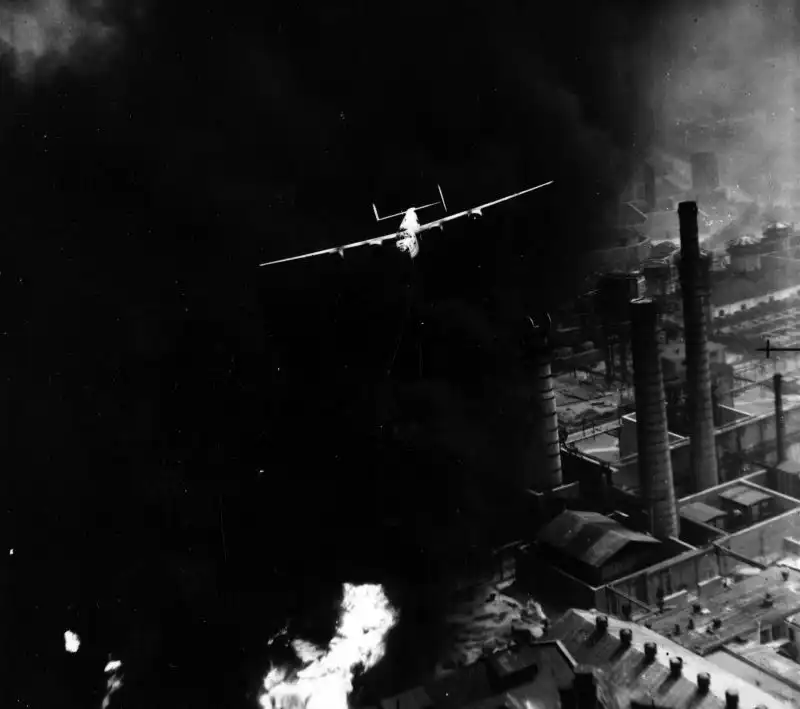
Iconic photograph of Consolidated B-24D Liberator "The Sandman" emerging from dense smoke and fires over the Astra Romana refinery in Ploesti during Operation Tidal Wave, August 1, 1943.
Operation Tidal Wave: Low-Level Raid on "Hitler's Gas Station":
This dramatic wartime photograph, captured on August 1, 1943, depicts one of the most famous and dangerous heavy bomber missions of World War II: Operation Tidal Wave. A Consolidated B-24D-55-CO Liberator named "The Sandman" (serial number 42-40402) is seen pulling away from the inferno of the Astra Romana oil refinery (target code White IV) in Ploești, Romania.
Pilot 1st Lt. Robert J. Stern navigated the four-engine bomber through towering smoke plumes, blazing oil fires, and intense German anti-aircraft fire at tree-top level—often flying below the height of the refinery chimneys.
Tactical Execution: Why Ultra-Low Level Altitude?
Standard Allied strategic bombing was conducted from high altitudes (20,000 to 25,000 feet). However, to maximize destruction on Axis oil production facilities, USAAF commanders planned a daring surprise attack at altitudes between 30 to 50 feet above ground level:
- Radar Evasion: Flying beneath German radar coverage allowed 178 B-24 bombers launched from Benghazi, Libya, to approach the Romanian border undetected.
- Surgical Precision: Low-altitude runs enabled bombardiers to drop delayed-fuse 1,000-pound bombs directly into key refinery distillation towers and boiler plants without using complex Norden bombsights.
- Extreme Danger: The low altitude exposed bombers to devastating light Flak fire, delayed bomb blasts from preceding aircraft, and high-risk mid-air collisions in dense smoke.
The Legacy of "The Sandman" and the 98th Bomb Group:
Attached to the 345th Bombardment Squadron, 98th Bombardment Group ("Pyramiders"), "The Sandman" survived the catastrophic raid despite taking multiple hits from ground fire and navigating through intense heat updrafts over the burning plant.
While Operation Tidal Wave successfully damaged significant portions of Axis oil production capabilities, it came at a staggering cost: 53 aircraft were lost and over 300 airmen were killed or captured, making it one of the costliest single USAAF aviation missions of the war, earning five Medals of Honor for participating airmen.
📍 Location: Ploești, Prahova County, Romania
📅 Date: August 1, 1943
📷 Photographer: Unknown (USAAF Official Photographer / Combat Camera Unit)
Recommended reading:
- Combat history and aircrew roster of B-24D Liberator "The Sandman" (42-40402)
- Strategic importance of the Ploești oil fields to the German war economy
- Detailed mission timeline of Operation Tidal Wave (August 1, 1943)
- Tactical structure of the 98th Bombardment Group ("Pyramiders") in North Africa