Historical aviation analysis of a downed Junkers Ju 87R long-range dive bomber bearing the 6G code of II./St.G 1, photographed in the Smolensk forest sector in the summer of 1941.
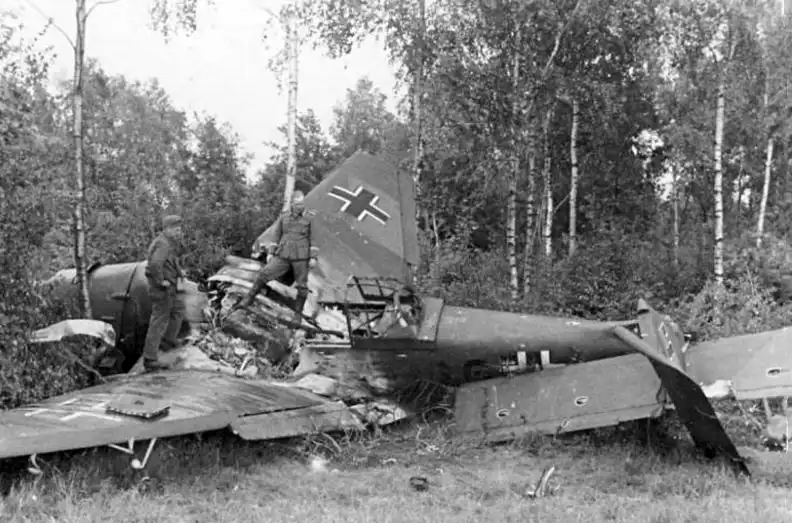
Wrecked Junkers Ju 87R "Stuka" of StG 1 in the Smolensk Forests (Summer 1941)
This striking historical photograph from the summer of 1941 captures the smoldering wreckage of a German Junkers Ju 87R "Stuka" dive bomber downed in the heavily wooded terrain of the Smolensk region during the intense air battles of the Eastern Front.
German soldiers are seen inspecting the ruined airframe, where the cockpit and forward fuselage have been completely gutted by fire following a catastrophic impact or forced landing.
Tactical Markings and Aircraft Identification
Careful analysis of unit codes and technical features reveals specific details regarding this aircraft:
- Variant Identification (Ju 87R): The "Reich" variant was a long-range modification of the Ju 87B, featuring underwing auxiliary fuel tank plumbing designed to extend operational range across vast Soviet territories.
- Unit Code (6G): The visible markings identify the aircraft as belonging to the II Gruppe of Sturmpilotengeschwader 1 (II./St.G 1), an elite dive-bomber group operating directly within the air support sector of Army Group Center (Heeresgruppe Mitte).
- Operational Timeline: During the winter of 1941–1942 (December through February), units belonging to StG 1 began transitioning away from older B and R variants to the heavily armored and upgraded Ju 87D series.
- Crash Environment: Surrounded by characteristic Russian birch trees, the wreckage illustrates the hazards faced by Luftwaffe close-air-support units operating over partisan-active and heavily defended Soviet frontline sectors.
Air Warfare During the Battle of Smolensk (1941)
In the summer of 1941, Stuka formations played a decisive tactical role in breaking up Red Army counter-offensives and supporting Wehrmacht armored spearheads. However, intense anti-aircraft fire, Soviet fighter opposition, and rugged field conditions led to heavy attrition among frontline dive-bomber squadrons.
📍 Location: Smolensk Region, RSFSR, USSR
📅 Date: Summer 1941
📷 Photographer: Unknown (Wehrmacht War Correspondent)
📰 Primary Source: Eastern Front Aviation Historical Archives
Recommended reading:
- Sturmpilotengeschwader 1 (StG 1): Combat history and operational areas on the Eastern Front
- Junkers Ju 87R Specifications: Long-range modifications and auxiliary fuel systems
- The Air War over Smolensk (1941): Luftwaffe operations during the central sector offensive
- Transition to the Ju 87D: Evolution, engine upgrades, and armor improvements in 1942