Detailed uniform and insignia analysis of a 1944 photograph depicting a decorated Wehrmacht Sturmartillerie crewman posing with a bottle on the Eastern Front.
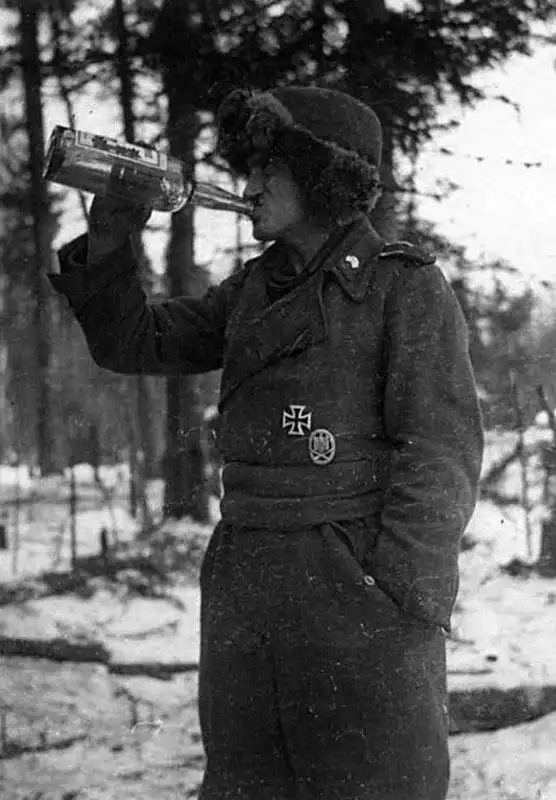
Wehrmacht Self-Propelled Gun Crewman in Winter (Eastern Front, 1944)
This candid photograph from the winter of 1944 captures a decorated German self-propelled gun (Sturmartillerie) crewman on the Eastern Front, posing playfully with a bottle during a brief lull in combat operations.
The image has been the subject of frequent historical discussion regarding uniform details, insignia, and branch identification.
Detailed Uniform and Insignia Analysis
A rigorous examination of the soldier's uniform and badges resolves common misconceptions between Wehrmacht armored artillery and Waffen-SS formations:
- Sturmartillerie Feldjacke: The crewman wears the field-grey (Feldgrau) double-breasted jacket introduced specifically for self-propelled assault gun (StuG) crews. Unlike the black tunics worn by standard Panzer units, Sturmartillerie personnel wore field-grey uniforms with red artillery piping.
- Prussian-Type Skull Insignia (Totenkopf): The collar tabs feature the small metal "Prussian style" skull without a lower jaw, standard for Wehrmacht armored and self-propelled units. This differs significantly from the larger, jawed skulls used on Waffen-SS collar tabs.
- Absence of SS Insignia: The tunic lacks the sleeve eagle (Ärmeladler) on the upper left arm and the cuff title (Ärmelstreifen) mandatory for SS formations, confirming his affiliation with the regular Army (Heeres-Sturmartillerie).
- Decorations: The soldier wears the Iron Cross 1st Class (EK I) on his left breast, a heavily worn Iron Cross 2nd Class (EK II) ribbon in the buttonhole, and a General Assault Badge (Allgemeines Sturmabzeichen).
- Winter Gear: He wears a heavy fur-lined winter cap (Wintermütze) suitable for severe Eastern Front conditions in early 1944.
The Role of Sturmartillerie on the Eastern Front
By 1944, German assault gun detachments (Sturmartillerie-Brigaden) equipped with StuG III and StuG IV vehicles served as the primary mobile anti-tank defense for infantry divisions along the retreating Eastern Front. Facing overwhelming armored odds, decorated StuG veterans frequently conducted continuous defensive operations in extreme winter conditions.
📍 Location: Eastern Front, USSR
📅 Date: Winter 1944
📷 Photographer: Unknown (Wehrmacht War Correspondent)
📰 Primary Source: WWII Eastern Front Military Archives
Recommended reading:
- Sturmartillerie Uniforms and Insignia: Distinguishing StuG crews from tank and SS personnel
- The StuG III on the Eastern Front: Tactical evolution from infantry support to tank destroyer
- Wehrmacht Medals and Badges: Iron Cross 1st Class and General Assault Badge criteria
- Winter Equipment of the Wehrmacht (1943–1944): Wintermütze and field clothing adaptations