German mountain troops inspect two knocked-out Soviet T-34-76 tanks built at the Stalingrad Tractor Plant (STZ) during the summer of 1942. The photograph highlights battlefield intelligence, STZ production features, and the expanding role of Wehrmacht Gebirgsjäger on the Eastern Front.
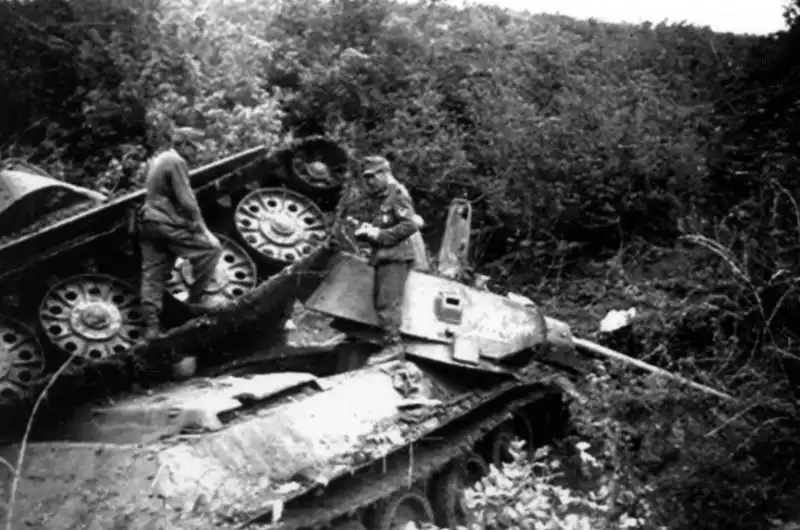
This wartime photograph shows Wehrmacht mountain troops (Gebirgsjäger) inspecting two knocked-out Soviet T-34-76 medium tanks manufactured at the Stalingrad Tractor Plant (STZ). Taken during the summer of 1942, it captures a quiet moment after the fighting, when German soldiers examined enemy equipment to evaluate both the battlefield and one of the Red Army's most formidable armored vehicles.
Why Were Mountain Troops Here?
Although trained primarily for mountain warfare, the Gebirgsjäger were increasingly committed wherever the fighting was most intense. During the German summer offensive of 1942, the demands of the Eastern Front stretched available manpower, and mountain divisions were frequently employed as conventional infantry across the southern sectors of the USSR.
Their presence beside destroyed Soviet tanks illustrates how specialized formations were often used far beyond their original mission, reflecting the enormous scale of the campaign.
What the Photograph Shows
The photograph depicts two disabled T-34-76 tanks that had already been knocked out and abandoned. Rather than engaging in combat, the German soldiers are carefully inspecting the vehicles.
After battles, such examinations served several practical purposes:
- checking for surviving crew members or usable equipment;
- examining armor construction and manufacturing details;
- confirming that the vehicles were beyond recovery;
- collecting technical intelligence for future operations.
STZ-Built T-34-76 Tanks
Both tanks were produced by the Stalingrad Tractor Plant (STZ), one of the Soviet Union's principal manufacturers of the T-34. As wartime pressure intensified, production methods were gradually simplified to maintain output despite shortages of skilled labor and constant demands from the front.
These manufacturing characteristics allow historians to identify many STZ-built tanks even when serial numbers are no longer visible.
Typical STZ Identification Features
- welded turrets characteristic of STZ production;
- cast road wheels with internal shock absorption;
- simplified construction designed for rapid wartime manufacturing.
Why the Germans Studied the T-34
By 1942, the T-34-76 had earned the respect of German armored forces. Captured and destroyed Soviet tanks were carefully examined to understand improvements in armor design, production techniques, and potential weak points.
Information gathered from battlefield inspections influenced both German tactical doctrine and the continuing development of armored fighting vehicles throughout the war.
The Eastern Front in the Summer of 1942
During the summer of 1942, German forces concentrated their main offensive toward southern Russia, the Volga, and the Caucasus. Although the Wehrmacht could no longer launch massive offensives along the entire front, its southern advance achieved considerable success during the opening months of the campaign.
The rapid movement of front lines left behind large numbers of damaged or destroyed armored vehicles, many of which became valuable sources of technical intelligence for both sides.
Historical Significance
This photograph documents more than two destroyed tanks. It illustrates several important aspects of the Eastern Front:
- identifiable STZ-produced T-34-76 tanks;
- German battlefield intelligence and technical inspection procedures;
- the deployment of Gebirgsjäger far beyond traditional mountain operations;
- the growing intensity of armored warfare during the 1942 campaign.
Photo Information
📷 Subject: Wehrmacht mountain troops inspecting two knocked-out STZ-built T-34-76 tanks
📍 Location: USSR
📅 Date: Summer 1942
📷 Photographer: unknown
Conclusion
More than a record of destroyed armor, this photograph captures a brief pause between battles. The silent T-34-76 tanks, surrounded by curious German soldiers, remind us that every battlefield also became a place of observation, analysis, and hard-earned military lessons. For historians today, images like this preserve not only the appearance of wartime equipment but also the realities of the campaign that shaped the Eastern Front in 1942.
Alt text: Wehrmacht mountain troops inspect two knocked-out Soviet T-34-76 tanks built at the Stalingrad Tractor Plant during the summer campaign in the USSR, 1942.
Recommended Reading
- Zaloga, Steven J. T-34 Medium Tank 1941–45. Osprey Publishing.
- Glantz, David M. To the Gates of Stalingrad. University Press of Kansas.
- Forczyk, Robert. Tank Warfare on the Eastern Front 1941–1942: Schwerpunkt. Pen & Sword Military.
- Jentz, Thomas L. Panzertruppen: The Complete Guide to the Creation & Combat Employment of Germany's Tank Force, 1933–1942. Schiffer Publishing.