Archival photograph documenting German Wehrmacht infantry casualties laid out for burial while surviving soldiers dig a mass grave on the Eastern Front, 1944.
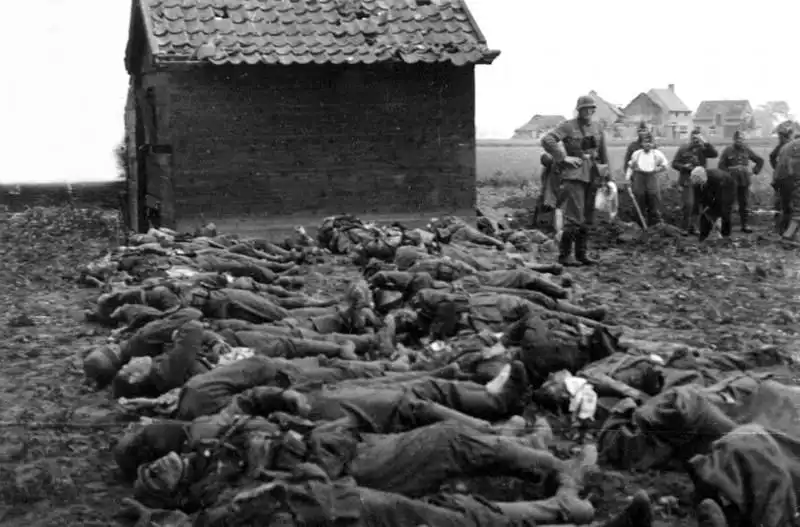
Wehrmacht Casualties and Field Burial Operations (1944):
This stark historical photograph from 1944 documents the aftermath of high-intensity combat operations on the Eastern Front. Dozens of fallen German Wehrmacht infantrymen are arranged in rows awaiting burial, while surviving soldiers are pictured in the background digging a mass grave near a farm building.
By 1944, catastrophic casualties among Axis military forces became a defining characteristic of the Eastern Front as the Red Army executed major strategic offensives across Ukraine, Belorussia, and the Baltic region.
Military Burial Protocols and Logistics:
The photograph illustrates standard field burial procedures utilized by military forces under combat conditions:
- Identification and Record Collection: Before burial, unit commanders or quartermaster personnel were tasked with collecting personal identification tags (Erkennungsmarken) and military paybooks (Soldbücher) to register official casualty lists.
- Field Graves (Graves Registration): In sectors undergoing rapid retreat or encirclement, standard individual graves with wooden markers were frequently replaced by hastily dug mass graves located near recognizable landmarks or structures.
- Logistical Strain: The sheer volume of casualties during 1944 operations continuously overwhelmed field medical units and grave registration details of the German Armed Forces.
Strategic Breakdown of Wehrmacht Forces in 1944:
The year 1944 marked the complete loss of strategic initiative for the Axis powers on the Eastern Front:
- Major Soviet Offensives: Large-scale operations such as Operation Bagration (Belorussia) and the Lviv–Sandomierz Offensive resulted in the destruction of whole army groups, including German Army Group Centre.
- Attrition Rates: German manpower reserves were severely depleted, forcing the deployment of under-trained conscripts and secondary service units directly to frontline combat zones.
- Archival Significance: Photographic documentation of enemy casualties served as key visual evidence for Allied intelligence assessments regarding the irreversible decline of German combat strength.
📍 Location: Eastern Front (USSR)
📅 Date: 1944
📷 Photographer: Unknown
📰 Primary Source: WWII Military History Archives / War Casualty Documentation
Recommended reading:
- Wehrmacht casualty statistics and manpower shortages on the Eastern Front (1944)
- The destruction of Army Group Centre during Operation Bagration
- German field grave protocols and Erkennungsmarken identification procedures
- Strategic impact of Red Army offensive operations in late World War II