Historic photograph of Red Army scout Mikhail Ganushenko holding a PPSh-41 and carrying captured German M-39 grenades on his belt, January 1944.
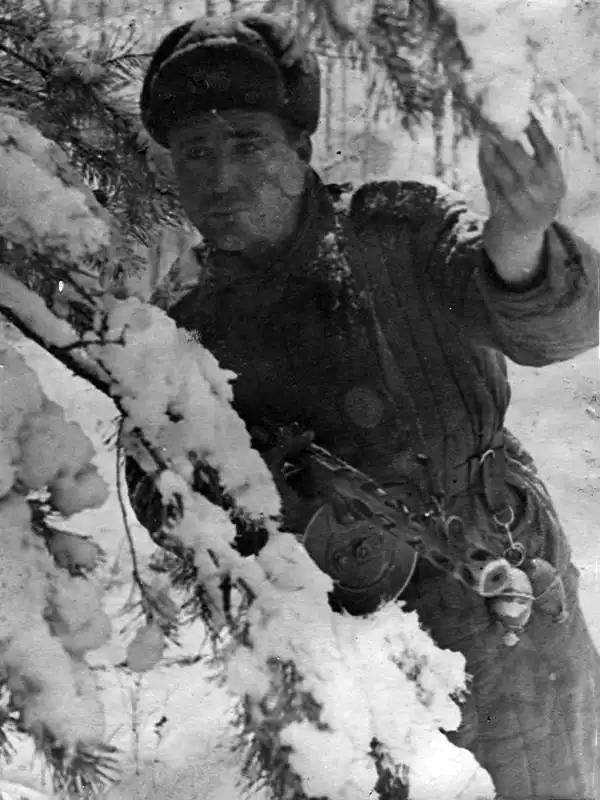
Soviet Scout Mikhail Ganushenko Observing Enemy Lines on the Belorussian Front (January 1944)
This poignant and detailed frontline photograph taken by war correspondent Yevgeny Podshivalov in January 1944 features Red Army scouts in Belarus (1944) hero Mikhail Fedorovich Ganushenko (1918–1944) carefully observing German positions on the Belorussian Front.
Ganushenko served in the 194th Tashkent Red Banner Rifle Regiment, part of the famed 162nd Central Asian Novgorod-Seversk Red Banner Rifle Division. Tragically, Red Army archival records confirm that Red Army man Ganushenko was killed in action on January 14, 1944, shortly before this image was published in Soviet wartime newspapers.
Equipment, Uniforms, and Visual Features
The photograph offers a rare close-up look at the customized gear and tactical field improvisations favored by frontline Red Army scouts:
- Captured German M-39 Grenades: Suspended from Ganushenko's waist belt is an improvised arrangement of captured German Eihandgranaten 39 (Model 1939 "egg" offensive hand grenades). The scout attached these light, friction-ignited grenades using non-standard metal clips and rings for quick access during trench raids.
- PPSh-41 Submachine Gun: The scout is armed with the iconic 7.62mm PPSh-41 submachine gun equipped with a high-capacity 71-round drum magazine, providing immense firepower essential for close-quarters reconnaissance combat.
- Winter Camouflage Technique: Wearing a padded winter jacket (telogreika) and winter fur cap (ushanka), Ganushenko carefully parts snow-covered pine branches with a gloved hand to prevent shaking loose snow, which could betray his concealed observation post to enemy snipers.
- Frontline Reconnaissance: Red Army scouting patrols operated ahead of main defense lines in extreme winter weather, gathering vital intelligence on enemy strongpoints and troop movements during preparation for major strategic offensives in Belorussia.
The Legacy of the 162nd Central Asian Division
Originally formed from NKVD border guard personnel and recruits across Central Asia, the 162nd Rifle Division gained a formidable combat reputation during operations in Russia, Belorussia, and Poland. Frontline photographs like this served as vital morale builders when published in national newspapers such as Vechernyaya Moskva in early 1944.
📍 Location: Belorussian SSR, USSR
📅 Date: January 1944
📷 Photographer: Yevgeny Podshivalov
📰 Primary Sources: Russian State Film and Photo Archive (photo.rgakfd.ru), Newspaper "Vechernyaya Moskva" (No. 15, Jan 18, 1944), and "Pamyat Naroda" WWII Memorial Database (pamyat-naroda.ru)
Recommended reading:
- Reconnaissance weapons: Combat employment of the PPSh-41 submachine gun in Red Army scout units
- Trophy equipment analysis: Soviet field modifications and use of captured German hand grenades
- Eastern Front division history: Combat path of the 162nd Central Asian Rifle Division
- Frontline photojournalism: The wartime photography of Yevgeny Podshivalov on the Belorussian Front