Historical 1945 photograph showing Soviet Navy field-modified Douglas A-20G Boston torpedo bombers equipped with glazed navigator noses and external torpedo racks at an airfield in Germany.
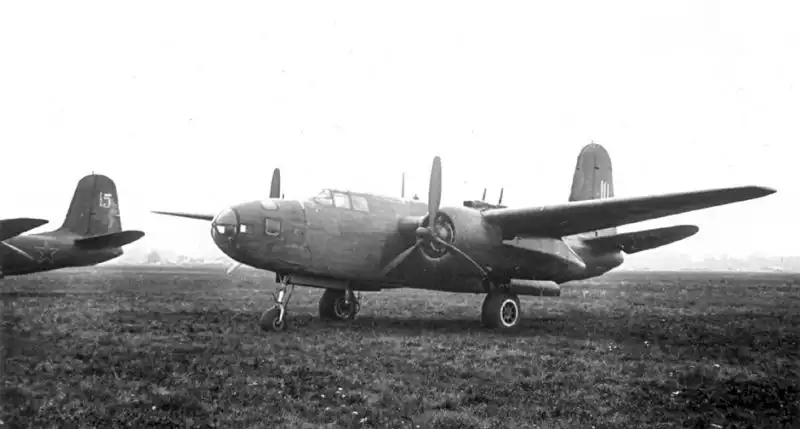
Soviet Naval Aviation A-20G Boston Torpedo Bombers on a German Airfield (1945)
This detailed historical photograph taken in Germany in 1945 captures field-modified Douglas A-20G Boston twin-engine torpedo bombers belonging to the Red Army Naval Aviation (AV-MF) parked on a frontline airfield during the closing stages of World War II.
While the American-supplied Lend-Lease A-20G was originally built as a heavy ground-attack aircraft with a solid gun nose, Soviet naval engineers implemented a series of extensive field modifications to convert these high-performance aircraft into dedicated long-range torpedo bombers and maritime strike platforms.
Technical Features of the Soviet Torpedo Conversion
The close-up perspective of Tactical No. 10 clearly illustrates the unique structural adaptations developed by Soviet field maintenance units:
- Glazed Navigator Cabin: The standard solid nose housing machine guns was completely removed and replaced with a hand-crafted glazed nose cabin, allowing a navigator-bombardier to handle maritime navigation, torpedo sighting, and precision aiming.
- Ventral Torpedo Mounts: Custom external torpedo crutches were fitted under the center fuselage to carry standard Soviet 45-36AV or 45-36AN aerial torpedoes for anti-shipping operations.
- Auxiliary Fuel Capacity: To match the long combat radius of domestic Il-4 torpedo bombers, Soviet mechanics installed an additional fuel tank directly inside the internal bomb bay.
- Formation Movement: In the left background, another modified A-20G (Tactical No. 15) is visible maneuvering across the airfield grass, highlighting the mass deployment of Lend-Lease aircraft in Baltic and Black Sea naval aviation regiments.
Operational Impact in the Baltic and North Seas
The high speed, heavy defensive firepower, and twin-engine reliability of the modified A-20G made it the most successful land-based torpedo bomber used by Soviet naval aviation against German shipping convoys in the Baltic, Black, and Barents Seas during 1944–1945.
📍 Location: Airfield in Germany
📅 Date: 1945
📷 Photographer: Unknown
📰 Primary Source: Central Naval Archive of the Russian Federation (TSVMA) / RGAKFD
Recommended reading:
- Lend-Lease naval tactics: Low-level torpedo strikes by Soviet A-20 Boston crews
- Field engineering: Structural redesign of the A-20G nose cone in Soviet workshops
- Armament specs: The 45-36AV aerial torpedo and Soviet anti-shipping operations
- Naval aviation history: The Baltic Fleet Air Force during the Berlin Offensive (1945)