Historical photograph from the Battle of Kursk (1943) depicting Soviet soldiers inspecting a disabled German Ferdinand (Sd.Kfz. 184) No. 711 of s.Pz.Jg.Abt. 654, featuring a soldier in a rare SSh-36 helmet.
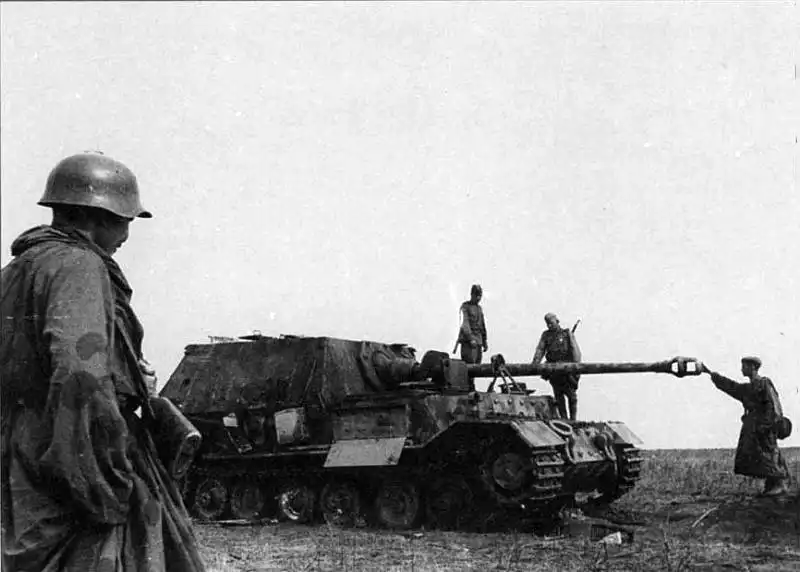
Red Army Soldiers Inspecting a Knocked-Out Ferdinand Tank Destroyer No. 711 at Kursk (1943)
This legendary archival photograph, captured during the Battle of Kursk in July–August 1943, portrays Soviet Red Army soldiers conducting a detailed field examination of a disabled German Ferdinand heavy tank destroyer (Sd.Kfz. 184) bearing tactical number 711.
Belonging to the 654th Heavy Anti-Tank Battalion (schwere Panzerjäger-Abteilung 654), this massive 65-ton armored vehicle was immobilized during intense combat on the northern flank of the Kursk salient.
The Legendary Ferdinand in the Battle of Kursk
Only 90 units of the Ferdinand tank destroyer were ever constructed, utilizing the Porsche VK 45.01 (P) heavy tank chassis rejected during the Tiger I production competition:
- Impenetrable Frontal Armor: Armed with the deadly 88mm PaK 43/2 L/71 gun and shielded by 200mm of front hull armor, the Ferdinand possessed immense long-range firepower but suffered from severe mobility limitations and a lack of organic defensive machine guns during its combat debut at Kursk.
- Heavy Losses at Ponyri: Attached to the 41st Panzer Corps under Army Group Center, s.Pz.Jg.Abt. 654 engaged dense Soviet minefields, artillery concentrations, and infantry anti-tank teams around the Ponyri station and Teplov Heights.
Rare Uniform Detail: The SSh-36 Steel Helmet
Beyond its armored warfare significance, the photograph is highly regarded by military historians for an exceptional uniform detail:
- Obsolete Headgear in 1943: The Soviet soldier standing in the left foreground wears an early-model SSh-36 steel helmet (distinguishable by its prominent front visor and top comb).
- Rarity on the Frontlines: By the summer of 1943, the Red Army had almost universally transitioned to the improved SSh-39 and SSh-40 steel helmets, making the operational survival of an SSh-36 helmet at Kursk a noteworthy visual record.
Archival Impact
Combat photographs of genuine Ferdinand tank destroyers—rather than other German assault guns often misidentified as 'Ferdinands' by frontline troops—provide invaluable primary records of armored attrition during the pivotal clash at Kursk.
📍 Location: Kursk Salient (Northern Flank / Ponyri sector), USSR
📅 Date: Summer 1943
📷 Photographer: Unknown (Soviet Frontline Press Corps)
📰 Primary Source: Red Army Armored Forces & Intelligence Archives
Recommended reading:
- The Ferdinand (Sd.Kfz. 184) at Kursk: Combat deployment of s.Pz.Jg.Abt. 653 and 654
- The 88mm PaK 43/2 L/71 Gun: Ballistics and penetration capabilities in 1943
- Evolution of Soviet Helmets: Differentiating the SSh-36, SSh-39, and SSh-40
- The Battle of Ponyri Station: The defensive shield of the 70th and 13th Armies