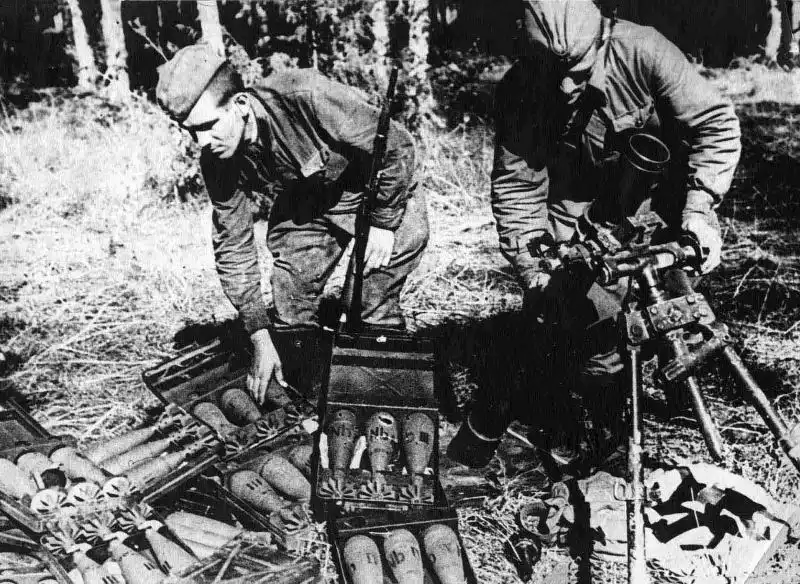
Red Army infantrymen examine a captured German mortar and its ammunition, illustrating how battlefield trophies were sometimes reused during the war.
The Eastern Front was not only a struggle between armies but also a constant battle for equipment, supplies, and ammunition. In the chaos of combat, weapons frequently changed hands, and both sides often made use of captured matériel whenever possible.
This photograph shows a group of Soviet soldiers armed with Mosin-Nagant rifles examining a captured German 8 cm Granatwerfer 34 (8 cm s.Gr.W.34) mortar and several rounds of ammunition during the summer of 1942.
The image offers a fascinating glimpse into an often-overlooked aspect of the war: the practical use of enemy weapons on the battlefield.
Germany's Standard Infantry Mortar:
The 8 cm s.Gr.W.34 was the standard medium mortar of the German Army throughout most of the Second World War.
Introduced before the war, it became one of the Wehrmacht's most important infantry support weapons. The mortar combined mobility, reliability, and effective firepower, allowing German infantry units to engage enemy troops hidden behind terrain features, buildings, or field fortifications.
The weapon fired a variety of ammunition, including:
- High-explosive rounds
- Smoke rounds
- Illumination rounds
- Special-purpose ammunition
In this photograph, the visible markings suggest that the captured rounds are smoke shells. The abbreviation "Nb" commonly referred to Nebel (smoke) ammunition in German military nomenclature.
Captured Weapons on the Eastern Front:
The enormous scale of the fighting in the Soviet Union created countless opportunities for both armies to capture enemy equipment.
During major offensives and retreats, entire depots, artillery batteries, and supply columns sometimes fell into enemy hands. Captured German machine guns, mortars, artillery pieces, and even tanks occasionally entered Soviet service.
Likewise, German forces made extensive use of captured Soviet weapons whenever ammunition and spare parts were available.
The Eastern Front became one of the few theaters of the war where soldiers frequently encountered weapons originally manufactured by the enemy but now being used against their former owners.
Soviet Use of Captured German Mortar Ammunition:
One particularly interesting aspect of this photograph concerns the ammunition lying beside the mortar.
The German mortar fired 81 mm rounds, while the standard Soviet battalion mortar used 82 mm ammunition. At first glance, this difference appears small, but it was significant enough to prevent direct interchangeability.
Soviet engineers nevertheless found a practical solution.
Special adapter rings were developed to increase the diameter of captured German mortar rounds from 81 mm to approximately 82 mm. Many of these rings were simple and inexpensive, sometimes even manufactured from paper-based materials.
This allowed at least some captured ammunition stocks to be fired from Soviet mortars rather than being discarded.
Reliability Problems:
Although the adaptation program was technically successful, it was not without drawbacks.
Reports from wartime sources indicate that modified German mortar rounds often displayed a higher rate of malfunction than standard Soviet ammunition.
Because of this, captured ammunition was frequently considered more suitable for:
- Training exercises
- Familiarization courses
- Instruction of mortar crews
However, battlefield realities often left little room for perfection. During periods of ammunition shortages, captured German rounds could still prove valuable.
Whether the mortar and ammunition seen in this photograph were intended for combat use or merely being inspected remains unknown.
Summer 1942: A Critical Year:
The photograph was taken during the summer of 1942, one of the most dramatic periods of the war on the Eastern Front.
Following the failure of the German offensive against Moscow in the winter of 1941–42, the Wehrmacht launched a new campaign aimed at southern Russia and the Caucasus oil fields.
At the same time, Soviet forces were desperately rebuilding their armies after the catastrophic losses of the previous year.
Every usable weapon mattered.
Captured enemy equipment represented not only an intelligence opportunity but also a potential source of desperately needed firepower.
Learning from the Enemy:
Photographs like this remind us that armies do more than fight. They constantly study, evaluate, and adapt.
The Soviet soldiers gathered around the mortar are not engaged in combat. Instead, they appear to be examining the weapon carefully, perhaps learning its operation, assessing its usefulness, or determining whether its ammunition can be employed by their own units.
Such moments of curiosity and technical investigation occurred countless times throughout the war and often contributed to practical battlefield innovations.
Conclusion:
This image captures more than a simple battlefield trophy.
It illustrates the resourcefulness demanded by total war, where even enemy ammunition could become a valuable asset. The captured German mortar and smoke rounds serve as a reminder that victory depended not only on courage and numbers but also on the ability to adapt and make use of every available resource.
For the Red Army of 1942, fighting for survival across thousands of miles of front, even a captured mortar could be worth careful examination.
Photo Details:
📍 Location: USSR
📅 Date: Summer 1942
📷 Photographer: Unknown
Recommended Reading:
- Soviet Mortars and Artillery of World War II
- German Infantry Weapons of World War II
- The Eastern Front 1941–1945
- When Titans Clashed
- Ivan's War
- The Red Army and the Second World War