A classic group portrait of a seven-man Royal Air Force crew standing proudly in front of their Avro Lancaster heavy bomber in England, 1943.
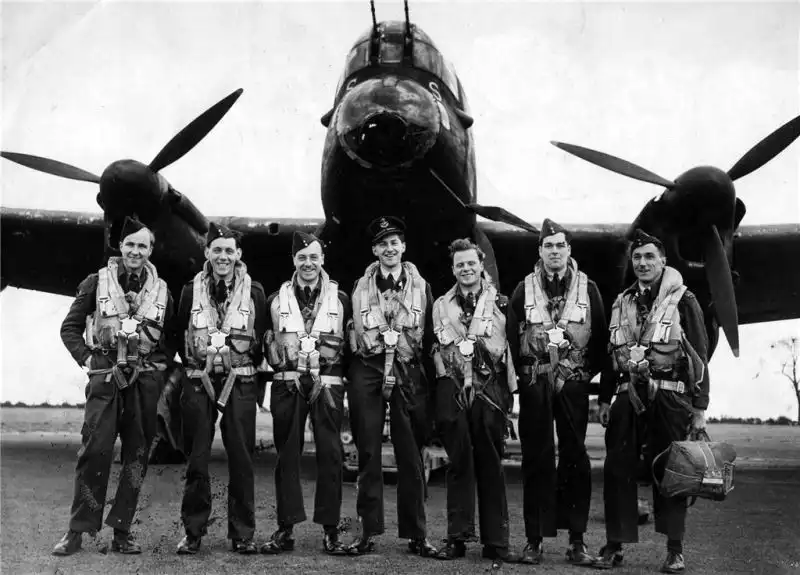
Group Portrait of a Royal Air Force Avro Lancaster Crew:
This iconic 1943 wartime photograph captures the complete seven-man flight crew of an Avro Lancaster heavy bomber standing in formation directly before the glass nose turret and iconic airframe of their four-engine aircraft at an airfield in England.
Outfitted in Irvin sheepskin flying jackets, canvas flight suits, "Mae West" life preservers, and parachute harnesses, these airmen represent the backbone of RAF Bomber Command during the height of the strategic night-bombing offensive over occupied Europe and Germany.
The Seven Essential Roles of a Lancaster Crew:
Unlike many American heavy bombers that carried ten or more crew members, the British Avro Lancaster was designed to operate with an optimized crew of seven highly trained specialists. Each man had a distinct and vital responsibility during dangerous night missions:
- Pilot (Captain): Seated at the aircraft's single-control column, responsible for flight operations, evasion maneuvers, and overall command of the bomber.
- Flight Engineer: Stationed beside the pilot, managing fuel flow, engine throttling (Merlin V-12s), hydraulic systems, and monitoring mechanical instruments.
- Navigator: Working in a curtained-off compartment behind the pilot, calculating precise course headings, wind vectors, and target approach tracks.
- Wireless Operator (Radio): Managing communications, intercepting base transmissions, and operating electronic radio navigation aids.
- Bomb Aimer / Front Gunner: Positioned in the nose, operating the bombsight during the target run and manning the nose power turret for defense.
- Mid-Upper Gunner: Operating the dorsal power turret located along the upper spine of the fuselage, providing 360-degree top hemisphere defense.
- Rear Gunner (Tail Gunner): Stationed in the isolated, freezing rear power turret with four .303 Browning machine guns, serving as the crew's critical lookout for approaching night fighters.
The Human Reality of Night Raids in 1943:
During 1943, RAF Bomber Command carried out devastating campaigns including the Battle of the Ruhr and the Battle of Hamburg. Operating in total darkness to evade German Flak and Luftwaffe radar-equipped night fighters (such as the Bf 110 and Ju 88), crew cohesion was the single most vital factor for survival.
Photographs like this were frequently taken for official RAF public relations records, local newspapers in the airmen's hometowns, and family keepsakes before crews embarked on their operational tours of 30 combat missions.
📍 Location: Airfield in England, United Kingdom
📅 Date: 1943
📷 Photographer: Unknown (Official RAF Air Ministry Photographer)
Recommended reading:
- Standard operating procedures and combat roles of an RAF Avro Lancaster crew
- Night tactical operations of RAF Bomber Command in 1943
- Evolution of the Avro Lancaster heavy bomber and Rolls-Royce Merlin engines
- Flight gear and survival equipment used by British aircrews in WWII