Historical photograph from November 1938 showing Polish military units operating near Jurgów during the occupation of Czechoslovak border territories in the Spiš region.
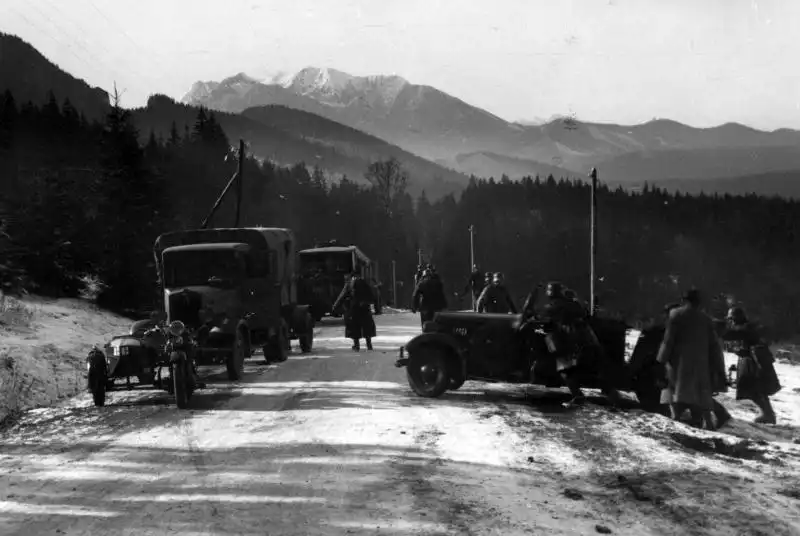
Polish Troops During the Annexation of Czechoslovak Spiš (November 1938)
This striking archival photograph, sourced from the National Digital Archives of Poland (audiovis.nac.gov.pl), captures Polish military units in November 1938 near the border village of Jurgów during the occupation of disputed Czechoslovak territories in the Spiš region.
While the village of Jurgów itself had become part of Poland back in 1920, the troops shown here were actively participating in the geopolitical realignment that followed the Munich Agreement, moving in to annex portions of southern Silesia and northern Slovakia under Prague's control.
The Geopolitical Context of Late 1938
The partition of Czechoslovakia stands as one of the critical prologue chapters to the outbreak of the Second World War:
- The Munich Agreement: Following the Western powers' appeasement of Nazi Germany and the handover of the Sudetenland, Warsaw issued its own ultimatum to Prague on October 1, 1938.
- Territorial Gains: Capitalizing on Czechoslovakia's isolation, Polish forces occupied the Teschen (Cieszyn) region, alongside border enclaves in Spiš and Orava, reclaiming areas with ethnic Polish minorities.
- Historical Irony: Less than a year later, the very forces that participated in the territorial dismemberment of Czechoslovakia found名 their own homeland overwhelmed by the Blitzkrieg launched by their temporary German partners in September 1939.
📍 Location: Spiš Region, Czechoslovakia (border area near Jurgów)
📅 Date: November 1938
📷 Photographer: Unknown (Polish Press Agency Archive)
📰 Primary Source: Narodowe Archiwum Cyfrowe (audiovis.nac.gov.pl)
Recommended reading:
- The Partition of Czechoslovakia (1938): Polish territorial claims and military actions
- The Teschen Conflict: Border disputes between Poland and Czechoslovakia in the interwar period
- Road to September 1939: How European border realignments shaped the outbreak of World War II