Historical photograph from November 1938 by Tadeusz Siemianowski showing a Polish TK-3 tankette and Fiat 508 car during the annexation of Spiš.
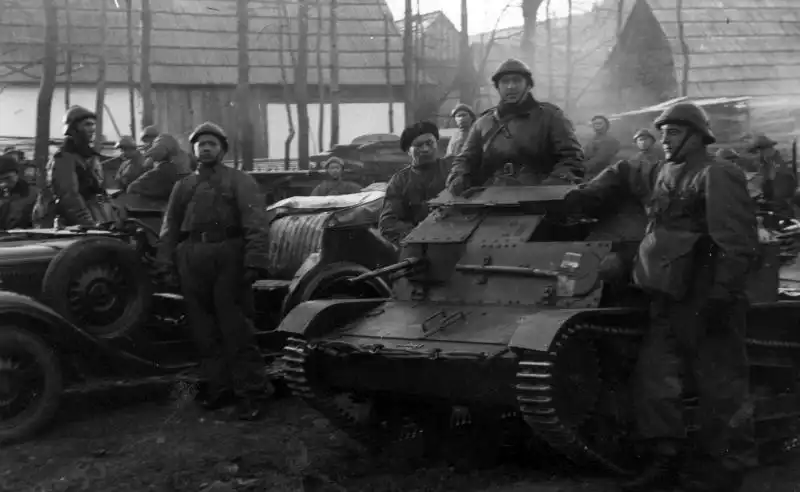
Polish TK-3 Tankette and Military Column in Jurgów (November 1938)
This archival photograph, captured by Tadeusz Siemianowski in November 1938 and preserved in Poland's National Digital Archives (audiovis.nac.gov.pl), showcases the motorized and armored elements of the Polish units operating in the village of Jurgów during the annexation of disputed Czechoslovak lands in the Spiš region.
In the foreground stands a Polish TK-3 tankette—the backbone of interwar Polish armored forces—accompanied to the left by a Fiat 508 utility and staff vehicle produced under Italian license domestically.
Armor and Logistics in the 1938 Operations
The deployment of tankette units during the occupation of Czechoslovak border areas highlighted the structural organization of the Polish army on the eve of World War II:
- The TK-3 Tankette: Developed from British Carden Loyd designs, these small, two-man tracked vehicles armed with machine guns were intended for reconnaissance and infantry support, though they were already technologically obsolete by 1939.
- Motorization of the Ranks: Alongside tracked armor, the column relies heavily on standard light transport like the Fiat 508, reflecting the logistical preparations of the Polish forces during the late 1930s border realignments.
📍 Location: Jurgów, Poland / Spiš Region
📅 Date: November 1938
📷 Photographer: Tadeusz Siemianowski
📰 Primary Source: Narodowe Archiwum Cyfrowe (audiovis.nac.gov.pl)
Recommended reading:
- Polish Armor Development in the 1930s: From Carden Loyd tankettes to the 7TP
- The Annexation of Spiš and Orava: Military deployment and tactical execution in 1938
- Fiat 508 in Polish Military Service: Staff cars and light transport of the interwar army