Historical archival photograph from October 1938 documenting a Polish cavalry parade in Karviná following the annexation of Zaolzie, highlighting the region's massive industrial and coal-mining value to Poland.
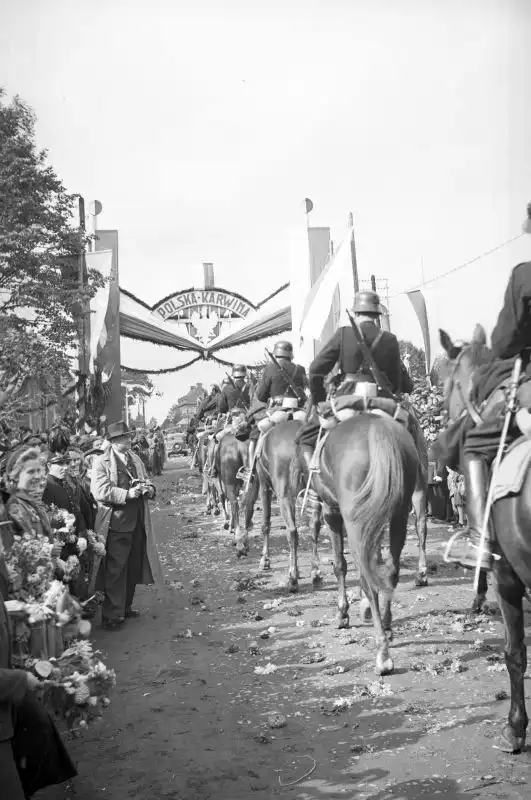
Polish Cavalry Parade in the Annexed Czech Industrial City of Karviná (October 1938)
This archival photograph, preserved in the National Digital Archive of Poland (NAC) and dated October 1938, captures units of Polish cavalry parading through the streets of the industrial Czech city of Karviná following the military occupation of the Zaolzie region.
Local crowds gather beneath a festive welcoming arch bearing the inscription “Polska-Karwina”, greeting the entering military detachments with flowers.
The Strategic and Economic Prize of Zaolzie
Beyond political ambitions, the annexation of the Teschen and Karviná districts provided an immediate and massive injection of heavy industrial power into the Polish economy:
- Industrial Heart-land: Karviná was a vital hub of coal mining, coking plants, and heavy metallurgy within the Ostrava-Karviná coal basin, representing some of the most advanced manufacturing infrastructure in Central Europe.
- Economic Windfall: By annexing these highly developed territories in late 1938, Poland dramatically expanded its industrial capacity, securing nearly 41% of its domestic pig iron production and nearly 47% of its steel output from captured Czech facilities almost overnight.
- Archival Record: Official state photographs from the NAC collection document the celebratory atmosphere surrounding an acquisition that significantly shifted regional economic power balances on the eve of World War II.
Historical Irony
The swift territorial gains of late 1938 highlighted a period of aggressive foreign policy during the final pre-war years. However, the integration of these industrial assets into the Polish state proved tragically brief, as the outbreak of hostilities in September 1939 led to the total collapse of existing borders and German incorporation of the region into Reichsgau Oberschlesien.
📍 Location: Karviná, Czechoslovakia (Zaolzie region)
📅 Date: October 1938
📷 Photographer: Unknown (Polish Press Agency / NAC Collection)
📰 Primary Source: Narodowe Archiwum Cyfrowe (audiovisiv.nac.gov.pl)
Recommended reading:
- The Annexation of Zaolzie (1938): Military strategy and territorial acquisition
- The Economic Impact of the Karviná Basin: How Czech industry fueled interwar Polish metallurgy
- Polish Cavalry in the 1930s: Role, equipment, and parades of the pre-war armed forces
- The Partition of Czechoslovakia: Munich Agreement consequences and regional repercussions