Historical archival photograph from October 1938 documenting Polish personnel posing with a removed Czechoslovak state crest at the captured telegraph office in Komorní Lhotka during the annexation of Zaolzie.
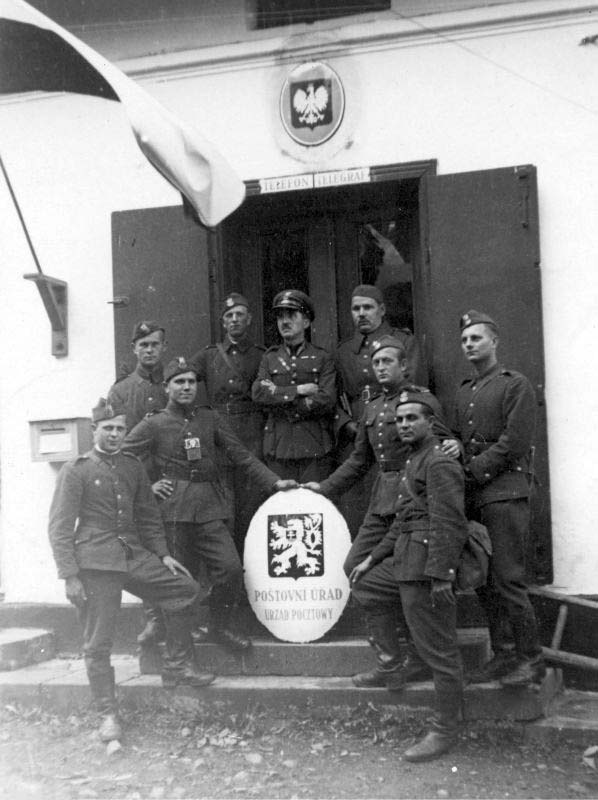
Polish Border Guards with Seized Czechoslovak Crest at Komorní Lhotka (October 1938)
This evocative archival photograph from October 1938, preserved in the National Digital Archive of Poland (NAC), captures a group of Polish security personnel—police and border guards—posing triumphantly outside the captured post, telephone, and telegraph office in the village of Komorní Lhotka (Polish: Ligotka Kameralna).
The unit has prominently displayed a freshly hoisted Polish eagle emblem above the doorway, while resting their feet on the demounted official Czechoslovak state crest featuring the traditional double-tailed Bohemian lion.
The Administrative Takeover of Zaolzie
The seizure of local infrastructure in rural border settlements marked the immediate implementation of Polish administration following the military occupation of Teschen Silesia:
- Communications and State Control: Securing post offices, telegraph stations, and railway junctions was an operational priority for incoming Polish forces to cut off communications with Prague and establish immediate administrative control.
- Symbolic Erasure: Beyond military movements, the operation involved the rapid replacement of state insignia, bilingual signage, and administrative frameworks across all annexed municipalities.
- Local Population Dynamics: While portions of the local populace greeted the changes with nationalist fervor, the sudden geopolitical shift drastically impacted minority populations and cemented a fragile, short-lived status quo in the region.
- Archival Documentation: Photographs from official repositories like the NAC offer an unvarnished look at the tactical and symbolic milestones of the October 1938 territorial expansion.
Historical Legacy
The events surrounding the partition of Czechoslovakia in late 1938 remain a sharply debated chapter of interwar European history, illustrating how regional tensions and opportunistic territorial grabs preceded the catastrophic global conflict that erupted less than twelve months later.
📍 Location: Komorní Lhotka (Ligotka Kameralna), Czechoslovakia
📅 Date: October 1938
📷 Photographer: Unknown (Polish Press Agency / NAC Collection)
📰 Primary Source: Narodowe Archiwum Cyfrowe (audiovis.nac.gov.pl)
Recommended reading:
- The Annexation of Zaolzie (1938): Administrative takeover and military logistics
- Czechoslovak Border Fortifications and Post Offices: State infrastructure during the 1938 crisis
- Teschen Silesia in the Interwar Period: Complex demographics and national rivalries
- The Munich Agreement and its Regional Consequences: How neighboring states capitalized on Czechoslovakia's partition