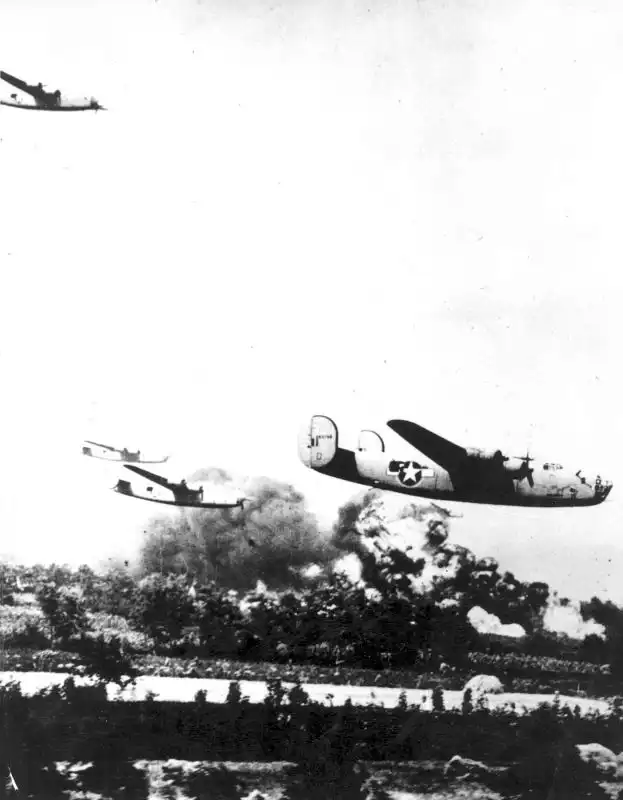
Iconic photograph of USAAF B-24 Liberator bombers flying ultra-low-level over targets during Operation Tidal Wave against the Axis oil refineries in Ploiești, Romania, August 1, 1943.
Operation Tidal Wave: The Low-Level Raid on Ploiești:
On August 1, 1943, 177 heavy bombers of the United States Army Air Forces (USAAF) launched Operation Tidal Wave—a daring, ultra-low-level strategic bombing strike aimed at destroying the vital Axis-controlled oil refineries in Ploiești, Romania.
This iconic photograph, captured from the lead aircraft of the 98th Bombardment Group piloted by Colonel John Riley Kane, captures B-24 Liberators skimming the ground at altitudes as low as 300 to 400 feet (100–150 meters) to evade radar detection, penetrating a wall of intense anti-aircraft fire and exploding storage tanks.
Aircraft Identification and Crew Details:
The image contains remarkable historical details from the 415th Bomb Squadron, 98th Bombardment Group ("Pyramiders"), 9th Air Force:
- Foreground Aircraft: The central B-24D Liberator is "Li'l Jughaid" (Serial No. 42-63758). It was piloted by First Lieutenant Lyle Spencer, with Second Pilot Harry J. Baker and Bombardier Boyden Supiani at the controls.
- Ground Explosion: The fireball visible in the lower right corner marks the tragic crash and explosion of B-24D "Tagalong" (Serial No. 42-24197). Only five crew members survived the catastrophic ground impact.
- Formation Aircraft: Visible in the background are additional 98th Group bombers, including the individual planes named "Daisy Mae" and "Black Magic".
Tactics, Resistance, and Extreme Low Altitude:
Operation Tidal Wave was unique in strategic aviation history due to its extreme low-level execution:
- Tree-Top Flight Level: Heavy bombers flew so low that ground crews later discovered stalks of corn lodged inside the bomb bay doors of returning Liberators.
- Ferocious Axis Air Defenses: The Ploiești refinery complex was heavily defended by dense Flak batteries commanded by Luftwaffe General Alfred Gerstenberg, as well as Romanian and German fighter squadrons (including Bf 109s and IAR 80s).
- Mission Cost and Results: The raid severely damaged approximately 40% of Ploiești’s refining capacity. However, USAAF losses were devastating: 54 aircraft were lost and 532 airmen were killed, captured, or wounded, making it one of the costliest single air missions for American aviation in WWII.
Archival Information and Historical Sources:
Due to the immense gallantry demonstrated during the mission, five Medals of Honor were awarded to participating airmen—the highest number for any single air action in US military history.
📍 Location: Ploiești, Prahova County, Kingdom of Romania
📅 Date: August 1, 1943
📷 Photographer: Unknown (USAAF Combat Camera Crew aboard Col. John Kane’s B-24)
📰 Primary Sources: Air Force Historical Support Division (afhistory.af.mil); Wikimedia Commons Archives

Recommended reading:
- Planning and tactical execution of USAAF Operation Tidal Wave (1943)
- Combat record of the 98th Bombardment Group ("Pyramiders") in the Mediterranean theater
- Strategic importance of the Romanian oil fields to the German war economy
- Low-level aerial navigation techniques of heavy strategic bombers