Archival 1944 photograph depicting a German Luftwaffe service member operating an NSU HK-101 Kettenkrad (Sd.Kfz. 2) tracked motorcycle on an airfield in Germany.
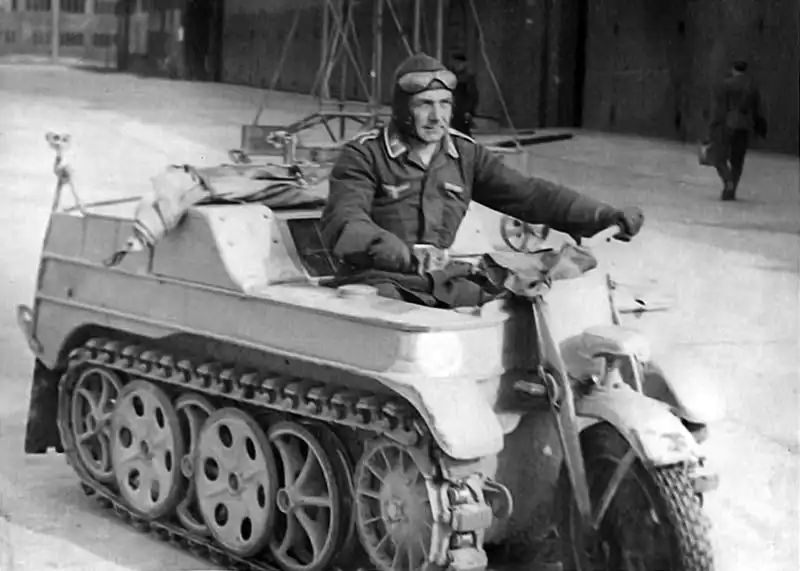
Luftwaffe Service Member Operating an NSU HK-101 Kettenkrad (1944)
This detailed archival photograph from 1944 shows a German Luftwaffe serviceman at the controls of an NSU HK-101 (Sd.Kfz. 2) Kleines Kettenkraftrad, a unique ultra-light half-track motorcycle hybrid, on a military airfield in Germany.
Wearing a traditional leather flight helmet (Fliegerhaube) and goggles, the driver maneuvers the vehicle across the tarmac. In Luftwaffe service, Kettenkrads were extensively deployed across operational airbases as aircraft tractors to tow fighters, bombers, and ammunition carts while conserving precious aviation fuel.
Technical Specifications and Mechanical Design
The Sd.Kfz. 2 combined motorcycle control ergonomics with the cross-country mobility of heavier military half-tracks:
- Powerplant: Positioned within the center frame was a 1.5-liter, 4-cylinder water-cooled engine adapted from the Opel Olympia passenger car, generating 36 horsepower.
- Transmission and Steering: Power was delivered through a 3-speed transmission to front drive sprockets. Gentle turns were executed via the single 19-inch front motorcycle wheel, while sharper turns automatically engaged track brakes on the inner drive sprocket.
- Suspension and Track System: Features four overlapping road wheels (Schachtellaufwerk) on each side with rubber-padded track shoes, providing exceptional traction over mud, snow, and rough terrain.
- Performance Metrics: Weighing 1,280 kg with a payload capacity of 325 kg, the Kettenkrad could achieve top speeds of up to 70 km/h (43 mph).
Post-War Civilian Service
Due to its exceptional terrain capability and fuel-efficient Opel automobile engine, thousands of surplus Kettenkrad vehicles remained in service across West Germany and Switzerland long after 1945, utilized by foresters, agricultural farmers, and alpine mail carriers.
📍 Location: Germany
📅 Date: 1944
📷 Photographer: Unknown (German Military / Private Photo Album Archive)
📰 Primary Source: Federal Archives of Germany (Bundesarchiv) / Imperial War Museum (IWM)
Recommended reading:
- Engineering overview: Design and mechanics of the Sd.Kfz. 2 Kettenkrad
- Airfield logistics: Towing procedures for Luftwaffe jet aircraft (Me 262 & Me 163)
- Automotive adaptation: The Opel Olympia 1.5L engine in Wehrmacht service
- Post-war utility: Civilian applications of German half-track vehicles in Europe