Pre-war 1938 photograph documenting a Wehrmacht Hauptfeldwebel conducting a strict uniform inspection (Appell) of young infantry recruits during morning routine.
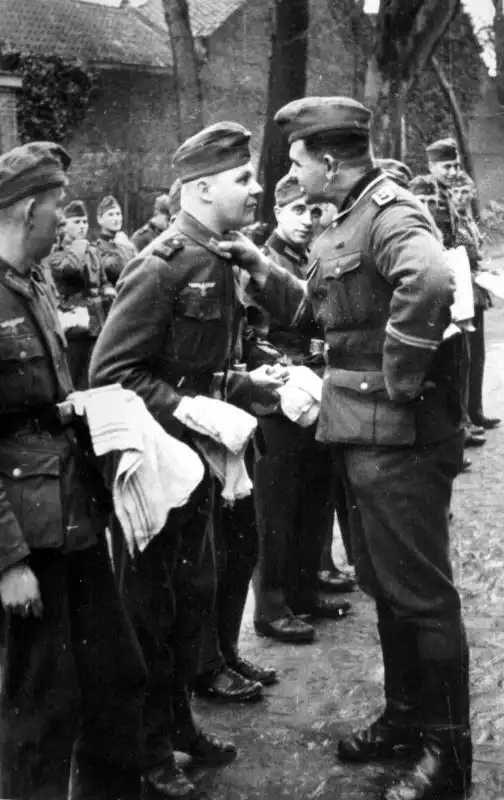
Pre-War Wehrmacht Uniform Inspection (1938)
This expressive pre-war photograph from 1938 captures a moment of military discipline within a German Wehrmacht infantry barracks yard. A stern senior non-commissioned officer serving in the appointment of Hauptfeldwebel conducts a meticulous inspection (Appell) of young recruits, reprimanding a soldier for an unbuttoned tunic collar and improper uniform neatness.
The soldiers standing in line hold towels and personal grooming kits, indicating the inspection took place during early morning barracks routine prior to field training exercises.
The Role of "Der Spieß" (Hauptfeldwebel)
The central figure exercising authority on the right holds one of the most vital administrative and disciplinary roles in the German army ground forces:
- Appointment Identification: The senior NCO is identified as the company first sergeant (Hauptfeldwebel), colloquially known among troops as "Der Spieß" ("The Spear") or "mother of the company."
- Sleeve Insignia (Kolbenringe): His appointment is visibly marked by the double rings of metallic silver NCO braid (Tresse) wrapped around both lower sleeves of his field tunic (M36 Feldbluse).
- Administrative Duties: While not a tactical rank itself, the appointment of Hauptfeldwebel was assigned to senior NCOs (typically Feldwebel or Oberfeldwebel) responsible for internal discipline, supply logistics, roll calls, and daily routine.
Uniform Regulations and Recruit Training (1938)
The interaction highlights the strict adherence to dress codes enforced during the pre-war expansion of the Wehrmacht:
- Collar and Neckband Discipline: The Hauptfeldwebel is seen physically inspecting the recruit's collar. German service tunics required a fresh, washable cotton neckband (Kragenbinde) buttoned inside the collar to protect the wool lining and maintain a uniform appearance.
- Field Service Caps (Feldmütze M34): The recruits wear early sidecaps (Feldmütze 34) featuring the national cockade and Wehrmacht eagle emblem, paired with standard wool field tunics fitted with dark green collars.
📍 Location: Germany
📅 Date: 1938
📷 Photographer: Unknown (Private / Barracks Album)
📰 Primary Source: Pre-WWII German Infantry Training and Uniform Regulations
Recommended reading:
- Duties and authority of the Hauptfeldwebel ("Der Spieß") in the Wehrmacht
- Evolution of the M36 field tunic and NCO rank insignia (Tresse)
- Daily routine and discipline in pre-war German infantry barracks (1935–1939)
- Design and regulations of the Wehrmacht M34 field sidecap (Feldmütze)