Archival photograph from February 1943 documenting the prison yard in Rostov-on-Don immediately after the city's liberation by the Red Army, featuring local relatives identification process.
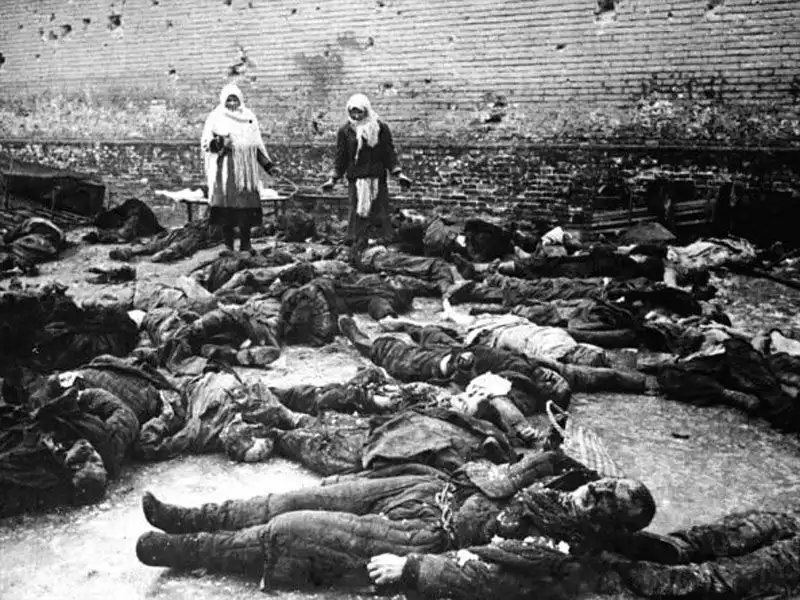
Historical Evidence: Rostov-on-Don Prison Yard Following Liberation (February 1943)
This solemn documentary photograph was taken in February 1943 immediately following the liberation of Rostov-on-Don by the Red Army during the Soviet Rostov Offensive Operation on the Southern Front.
The photo documents the yard of the central Rostov prison on Bogatyanovsky Avenue, capturing local residents who arrived at the scene shortly after Axis forces withdrew to search for and identify missing family members and relatives.
Equipment, Uniforms, and Visual Features
The photograph serves as a critical historical primary source recorded for state documentation and investigation committees:
- Prison Yard Setting: The foreground and midground portray the open exercise yard of the city prison complex, bordered by a massive brick perimeter wall showing damage from light weapons fire and shrapnel impact.
- Identification Process: Two local women wearing traditional winter headscarves and coats stand in the background, witnessing the scene during the identification process organized following the city's recapture.
- Forensic Documentation: Images of this nature were systematically collected by military correspondents and members of the Extraordinary State Commission (YSK) to record damage and casualties during the occupation period.
- Winter Conditions: The cold ground and patches of melting snow reflect the harsh winter weather conditions of February 1943 in Southern Russia.
Historical Context: The Battle for Rostov (1941–1943)
Rostov-on-Don, often referred to as the "Gateway to the Caucasus," experienced two distinct periods of Axis occupation during World War II: the brief "First Occupation" in November 1941, and the prolonged "Second Occupation" from July 1942 to February 1943. When Soviet troops of the Southern Front liberated the city on February 14, 1943, official investigative commissions immediately began recording the extensive infrastructure damage and human casualties left in the conflict's wake.
📍 Location: Rostov-on-Don, Rostov Oblast, RSFSR, USSR
📅 Date: February 1943
📷 Photographer: Unknown (Red Army Military Correspondent / YSK Archives)
📰 Primary Source: State Archive of the Russian Federation (GARF)
Recommended reading:
- Rostov Offensive Operation: The liberation of Rostov-on-Don by the Southern Front in February 1943
- Historical Documentation: The role of the Extraordinary State Commission in recording WWII damage
- Battle of the Caucasus: Strategic importance of Rostov-on-Don as a key transport hub
- Archival Photography: Methods of Soviet wartime forensic and journalistic photography