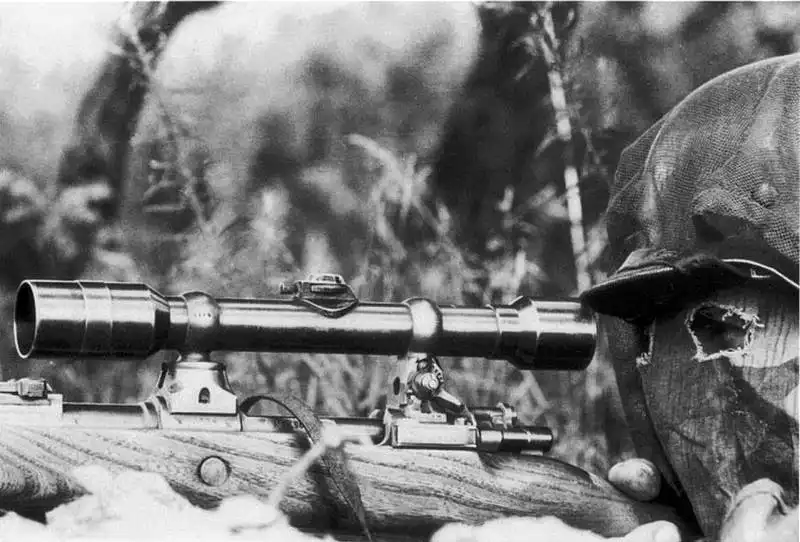
A German sniper wearing a crude camouflage face mask with a Kar98k rifle. A rare WWII image showing concealment tactics and sniper equipment.
The Face of Concealment:
This striking World War II photograph shows a German sniper wearing a crudely made camouflage face mask with rough eye openings.
Unlike standard uniforms, this mask appears improvised —
👉 Handmade
👉 Functional
👉 Designed for one purpose: invisibility
It reflects the brutal logic of sniper warfare —
you are seen, you are dead.
The Weapon – Karabiner 98k with Scope:
The sniper is armed with a Karabiner 98k, fitted with a telescopic sight.
Specifically, this is a sniper-configured variant:
- Zf.Kar.98k platform
- Equipped with the Zf.39 scope
Adopted in 1939, this setup featured:
- 4× magnification
- Mounting on the receiver
- Improved long-range targeting capability
It was among the early standardized sniper systems of the German army.
Evolution of German Sniper Optics:
Combat experience quickly revealed problems with early optics like the Zf.39.
As a result, the Germans introduced the Zf.41 scope in 1941.
However, this new scope had serious drawbacks:
- Very narrow field of view
- Poor target tracking
- Limited effectiveness against moving targets
Ironically, the attempt to improve usability made the system less effective in real combat conditions.
Return to More Effective Designs:
By 1944, German engineers returned to a more practical solution with the ZF.4 scope.
This improved optic offered:
- 4× magnification
- Better adjustment in multiple planes
- More stable mounting
It was essentially a refined successor to earlier designs.
The Mask: Improvisation in War:
The most visually powerful element of the photograph is the sniper’s face mask.
Unlike factory-produced camouflage:
- It is roughly cut
- Likely made from fabric or netting
- Designed to break the outline of the face
This highlights a key truth:
👉 Standard gear was not always enough
Snipers often created their own camouflage solutions based on terrain and conditions.
Sniper Warfare on the Eastern Front:
German units on the Eastern Front increasingly relied on snipers.
Their roles included:
- Eliminating officers
- Suppressing enemy positions
- Psychological warfare
Every side in the conflict recognized the value of trained marksmen.
The Psychology of the Sniper:
Unlike regular infantry combat, sniper warfare was:
- Slow
- Patient
- Highly individual
A sniper might wait:
- Hours
- Or even days
For a single shot.
The mask in the photograph is not just camouflage —
it is part of that mindset.
A Hunter, Not a Soldier:
This image shows a transformation:
From:
- Standard infantryman
To:
- Hidden observer
- Precision shooter
- Silent threat
The rough mask reinforces that shift.
No uniform identity — only function.
Historical Photograph Information:
Location: Unknown
Date: Unknown
Photographer: Unknown
Recommended Books on Snipers in World War II:
1. Sniper on the Eastern Front — Albrecht Wacker
2. Enemy at the Gates — William Craig
3. The German Sniper 1914–1945 — Peter R. Senich
4. Sniper: A History of the US Marksman — Martin Pegler