Detailed historical and deductorial analysis of a September 1939 photograph depicting a burning Messerschmitt Bf 110C-1 heavy fighter of I./ZG 76 featuring a single victory marking in Poland.
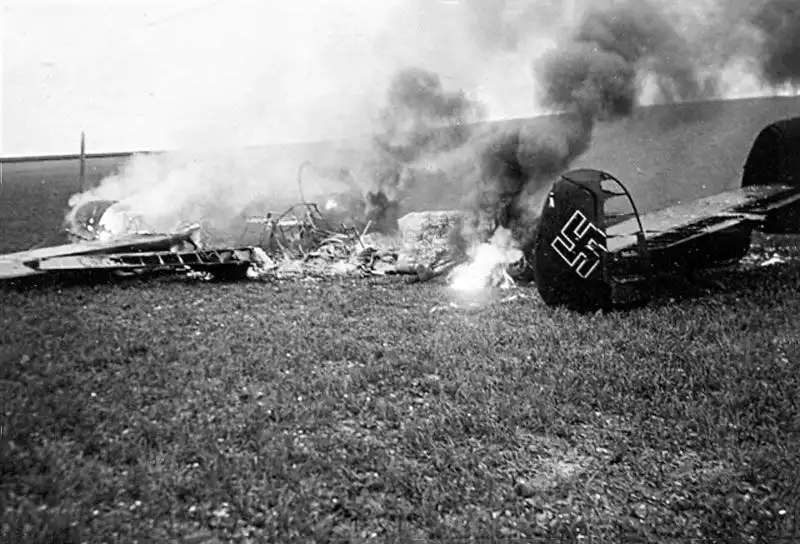
Downed Messerschmitt Bf 110C-1 of I./ZG 76 in Poland (September 1939)
This dramatic archival photograph from September 1939 documents the smoldering wreckage of a German Messerschmitt Bf 110C-1 heavy fighter (Zerstörer) downed during the Invasion of Poland (Kampania wrześniowa).
While the central airframe and cockpit area are engulfed in flames, the intact tail assembly provides valuable visual markers for unit identification and early-war Luftwaffe markings.
Tactical Markings and Unit Identification Investigation
Historical analysis of the airframe details and marking placement allows for a precise identification of the aircraft and its operational group:
- Swastika Placement: The swastika is positioned directly in the center of the vertical stabilizer, a classic paint scheme standard utilized during the initial 1939 operations before later camouflage standardization.
- Victory Bar (Abschussbalken): A single white victory stripe is visible on the tail fin, indicating a confirmed aerial victory scored by the crew against the Polish Air Force prior to being brought down.
- Deductive Unit Identification (I./ZG 76): Cross-referencing combat loss records and painting traditions confirms the aircraft belonged to I. Gruppe / Zerstörergeschwader 76 (I./ZG 76). Other candidate units are ruled out: I./ZG 1 suffered no losses corresponding to single-victory pilots during this timeframe, while I.(Z)/LG 1 placed victory tallies on the forward nose section rather than the vertical fin.
- Crash Scene: The aircraft rests in an open field following a catastrophic emergency landing or impact, with intense fire destroying the light aluminum fuselage structure.
Heavy Fighter Operations in the 1939 Campaign
During the opening campaign of World War II, the Bf 110C was deployed to establish air superiority and escort He 111 and Do 17 bomber formations. Despite technological superiority, Zerstörer squadrons encountered stubborn resistance from agile Polish PZL P.11 fighters and ground anti-aircraft defenses, leading to notable early losses among Luftwaffe heavy fighter crews.
📍 Location: Poland
📅 Date: September 1939
📷 Photographer: Unknown (Wehrmacht War Correspondent)
📰 Primary Source: WWII Military Aviation Historical Archives
Recommended reading:
- Zerstörergeschwader 76 (ZG 76): Operational deployment and losses in the 1939 Polish Campaign
- Messerschmitt Bf 110C Development: DB 601 engines and heavy twin-engine fighter tactics
- Luftwaffe Tail Markings 1939: Evolution of swastika dimensions and victory bars (Abschussbalken)
- Polish Air Defense (September 1939): PZL P.11 fighters vs. Luftwaffe twin-engine escorts