Historic 1942 photograph of a dancing Crimean Tatar auxiliary volunteer wearing an "Im Dienst der Deutschen Wehrmacht" armband on the Southern Coast of Crimea, featured in Nazi propaganda publications.
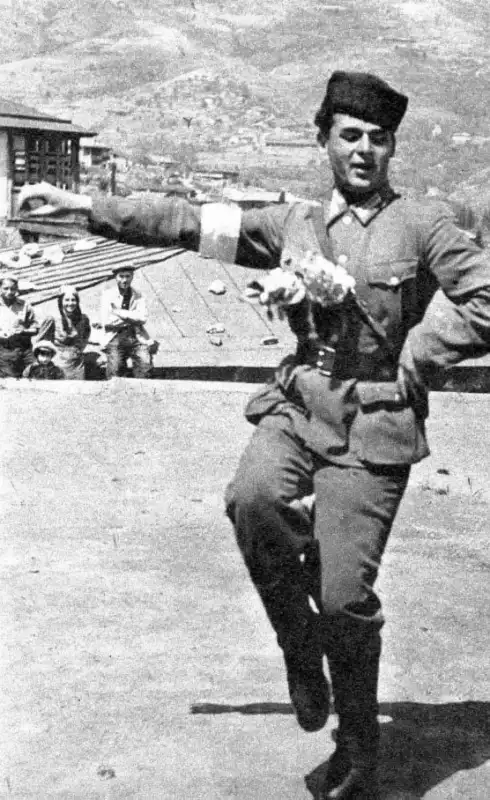
Dancing Crimean Tatar Wehrmacht Volunteer in Crimea (1942)
This widely recognized propaganda photograph taken in 1942 depicts a young Crimean Tatar volunteer from a local self-defense unit (Selbst-Schutz) performing a traditional dance with flowers on the Southern Coast of Crimea during the German military occupation (see also: Soviet Anti-Aircraft Gunners in Liberated Sevastopol).
Used extensively by German wartime propaganda organs, this photograph notably featured in the official Wehrmacht color magazine Signal to highlight indigenous auxiliary participation within Axis-controlled territories of the Soviet Union.
Equipment, Uniforms, and Visual Features
The image highlights key uniform identifiers and contextual details of local auxiliary forces in German service during 1942:
- Service Armband: Fastened to his upper right sleeve is a standard white cotton armband bearing the black printed German inscription "Im Dienst der Deutschen Wehrmacht" ("In the Service of the German Armed Forces").
- Uniform Attire: The volunteer wears an early-issue simplified field tunic with buttoned pockets and a side cap (Schiffchen).
- Cultural Context: The soldier holds a small bouquet of flowers while performing traditional dance steps on an elevated outdoor terrace overlooking Crimean coastal village architecture and spectators.
- Propaganda Staging: The photograph represents a classic example of staged wartime photojournalism intended for European and domestic German distribution.
Collaboration and Auxiliary Formations in Crimea (1941–1944)
According to historical documentation compiled by historian Oleg Romanko in Crimea Under Hitler's Heel, an estimated 20,000 local Crimean Tatars served across various Axis auxiliary, police, and paramilitary organizations during the occupation period:
- Self-Defense Units (Selbst-Schutz): Approximately 7,000 personnel organized primarily for anti-partisan operations and village defense.
- Voluntary Assistants (Freiwillige / HiWi): Around 9,000 individuals serving in non-combat logistical and support roles with German field units.
- Auxiliary Order Police (Schutzmannschaften): Roughly 7,000 men serving in local police battalions.
- Waffen-SS and Mountain Units: 2,421 personnel in the Tatar Mountain Infantry Brigade of the Waffen-SS, alongside 2,500 fighters in Battle Group "Krim" of the East Turkestan Armed Formation.
📍 Location: Southern Coast of Crimea, USSR
📅 Date: 1942
📷 Photographer: Unknown (Wehrmacht War Correspondent / Propaganda Kompanie)
📰 Primary Source: Signal Magazine / Oleg Romanko Archive (Crimea Under Hitler's Heel, 2011)
Recommended reading
- Axis foreign volunteers: Organization and roles of Eastern Legions in the Wehrmacht
- Occupation of Crimea: Administrative policy and anti-partisan warfare on the Crimean Peninsula (1941–1944)
- Wartime propaganda: The editorial style and circulation of Signal magazine
- Auxiliary police units: Structure and deployment of Schutzmannschaft battalions in Southern Ukraine