Historical photograph by Emmanuil Evzerikhin capturing a Red Army collection depot for captured German bicycles in Bischofsburg (now Biskupiec, Poland).
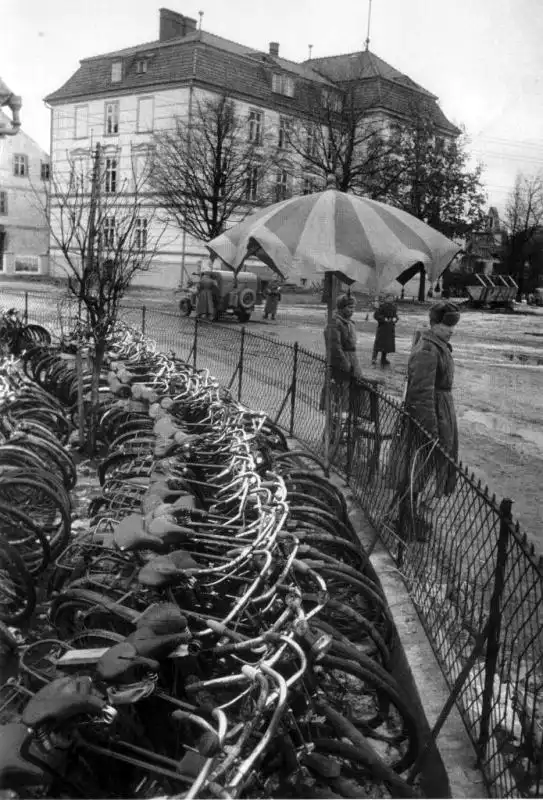
Collection Point of Captured Bicycles in Bischofsburg, East Prussia (1944)
This remarkable archival photograph, taken by legendary TASS war correspondent Emmanuil Evzerikhin, captures a Red Army collection point for captured and surrendered bicycles in the East Prussian town of Bischofsburg (now Biskupiec, Poland).
Guarded by armed Soviet sentries stationed near a striped parasol post, hundreds of bicycles are systematically arranged in rows behind a wire fence—a testament to the widespread military and civilian reliance on non-motorized transport during World War II.
Bicycles as Military Transport in World War II
To modern observers, the widespread military use of bicycles might seem archaic, yet two-wheeled transport played a vital, stealthy role across multiple theaters of operation:
- Speed and Mobility Without Fuel: Bicycle troops could cover up to 50–80 kilometers a day silently along unpaved tracks without consuming precious fuel or requiring complex mechanical supply chains.
- The Japanese Blitzkrieg in Malaya (1941): Colonel Masanobu Tsuji's force of 20,000 bicycle-mounted infantry navigated jungle paths to attack Singapore from the landward rear, outmaneuvering British forces tied to railways and paved roads.
- Commando Operations and Airborne Assaults: Special units, such as the British paratroopers during the famous 1942 Bruneval Radar Raid, utilized folding BSA Airborne bicycles to cover ground rapidly and quietly after landing behind enemy lines.
- German Radfahr-Bataillone: The Wehrmacht deployed specialized bicycle reconnaissance and infantry squadrons equipped with trailers for towing ammunition, mortars, and medical supplies across Poland, France, and Russia.
Requisition and War Trophies
During Axis occupations, mass requisitions of civilian bicycles were common—most notoriously in the Netherlands in 1940, where German authorities confiscated nearly two million bicycles, a historical memory that persists in popular culture to this day. During the Soviet advance into East Prussia, abandoned or surrendered bicycles were collected in central urban depots to equip rear-area messengers, logistics personnel, and local administrative commandants.
📍 Location: Bischofsburg (Biskupiec), East Prussia / Poland
📅 Date: 1944–1945
📷 Photographer: Emmanuil Evzerikhin (TASS Press Corps)
📰 Primary Source: Soviet Frontline Photo Archives
Recommended reading:
- Bicycle Troops in World War II: Tactics of Japanese, German, and British bicycle units
- The Bruneval Raid (1942): How folding bicycles helped capture German Wurzburg radar components
- Emmanuil Evzerikhin in East Prussia: Documenting the liberation of cities and field depots
- Logistics of the East Prussian Offensive: Handling trophies and non-motorized equipment