African American soldiers of the U.S. Army's 93rd Infantry Division training at Fort Huachuca, Arizona, in 1942 before deployment to the Pacific Theater.
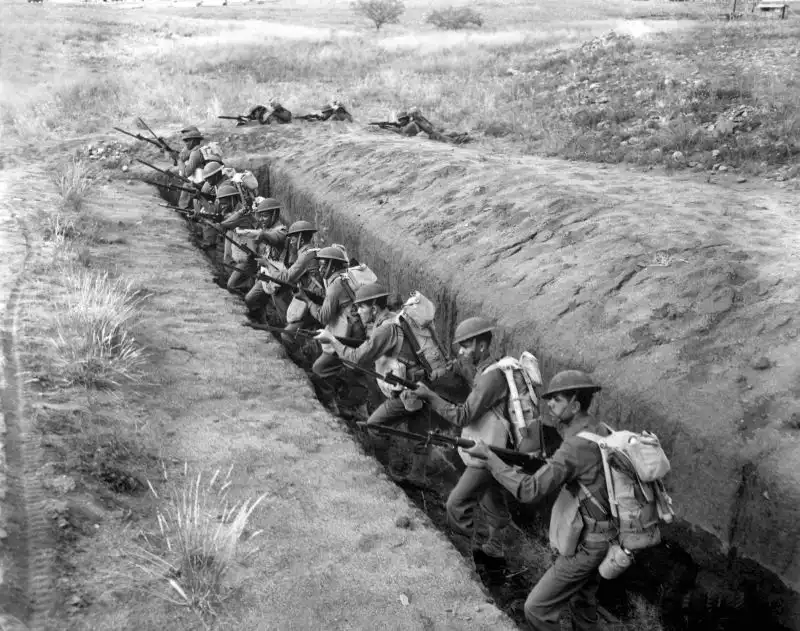
This photograph shows soldiers of the 93rd Infantry Division during field training at Fort Huachuca, Arizona, in 1942. The division was one of the principal African American combat formations of the U.S. Army during World War II and was preparing for deployment to the Pacific Theater.
The image documents not only military training but also a chapter of American history in which thousands of Black soldiers served in a racially segregated armed force.
The 93rd Infantry Division
The 93rd Infantry Division was reactivated on 15 May 1942, reviving a formation that had originally existed during the First World War. Like most African American combat units of the period, it was organized under the U.S. Army's policy of racial segregation.
The division eventually served in the Pacific, carrying out combat, security, and occupation duties on several islands during the final years of the war.
Key facts about the division include:
- Reactivated on 15 May 1942
- Composed primarily of African American enlisted personnel
- Served in the Pacific Theater from 1944
- Returned to the United States in February 1946
- Inactivated shortly after the end of the war
Training at Fort Huachuca
Fort Huachuca, Arizona, was one of the most important training centers for African American soldiers during World War II. Thousands of recruits completed infantry, artillery, engineer, and support training there before being assigned to units overseas.
The photograph identifies Second Lieutenant Arthur Bates, who is waiting for "Hour X"—the scheduled moment to order an assault during a field exercise. The scene illustrates the realistic tactical training designed to prepare officers and enlisted men for combat conditions.
Segregation in the U.S. Army
When this photograph was taken, the United States Army remained officially segregated. African American soldiers generally served in separate units under policies that limited opportunities for promotion and assignment, despite their growing contribution to the war effort.
Many segregated units performed with distinction in Europe and the Pacific, contributing to a broader debate about racial equality both during and after the war.
Formal segregation in the U.S. Armed Forces ended on 26 July 1948, when President Harry S. Truman signed Executive Order 9981, directing equal treatment and opportunity throughout the military.
The Pacific Campaign
The 93rd Infantry Division was deployed to the Pacific, where its regiments operated on islands including New Guinea, Bougainville, Morotai, and the Philippines. In addition to combat operations, the division performed security, construction, and occupation duties that supported Allied operations across the theater.
Although its combat record has often received less attention than that of some other American divisions, its service formed an important part of the overall Allied campaign against Japan.
Historical Significance
This photograph is valuable because it documents several aspects of World War II history simultaneously:
- Training of the 93rd Infantry Division before overseas deployment
- Military life at Fort Huachuca
- The existence of racially segregated combat units in the U.S. Army
- The contribution of African American soldiers to the Allied war effort
Beyond its military value, the image reflects the contradictions of wartime America—a nation fighting against aggressive dictatorships abroad while maintaining racial segregation within its own armed forces.
Photo Information
- Subject: Soldiers of the 93rd Infantry Division during training
- Location: Fort Huachuca, Arizona, United States
- Date: 1942
- Photographer: Carl Gaston
Recommended Literature
- Ulysses Lee — The Employment of Negro Troops
- Gail Lumet Buckley — American Patriots
- Gerald Astor — The Right to Fight
- Douglas Bristol Jr. — Knights of the Razor (background on African American military society during the era)
This photograph of the 93rd Infantry Division at Fort Huachuca captures more than a routine training exercise. It records a generation of soldiers preparing for war while serving in an army that remained legally segregated. Their experience forms an important part of both the military history of World War II and the broader history of civil rights in the United States.
👉 Related: African American soldiers in World War II • U.S. Army segregation • Pacific Theater