Damaged Soviet T-34-76 tanks gathered at a collection point for disabled armored vehicles near Stalingrad in 1942. Intended for evacuation and repair, they were abandoned during the rapid German advance and later captured by the Wehrmacht.
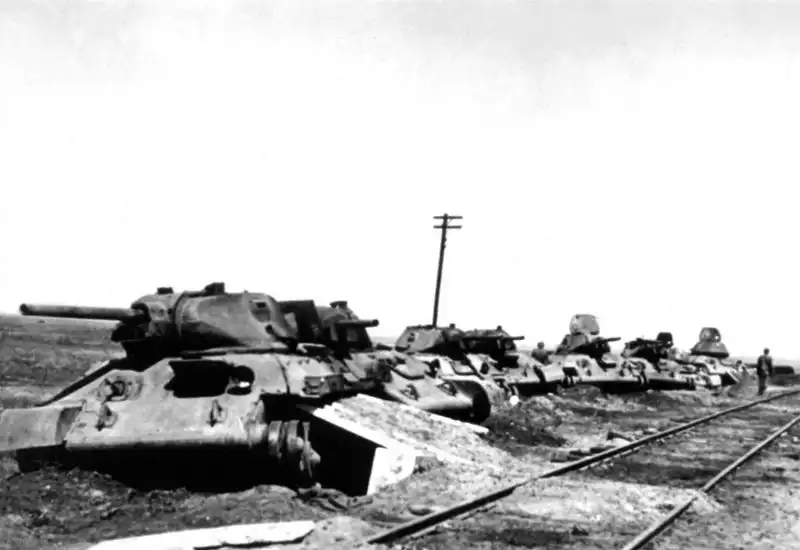
Damaged T-34-76 Tanks Awaiting Evacuation Near Stalingrad
This wartime photograph shows several damaged T-34-76 medium tanks gathered at a Red Army collection point for disabled armored vehicles near Stalingrad in 1942. Rather than being destroyed on the battlefield, these tanks had been recovered from combat and were awaiting evacuation to repair facilities.
Before they could be transported to the rear, however, the rapidly advancing German forces overran the area. The repair depot was abandoned, leaving dozens of damaged but potentially repairable vehicles to fall into Wehrmacht hands.
Collection Points for Damaged Tanks
Throughout the war, the Red Army established collection points where damaged armored vehicles were inspected before being either repaired locally or evacuated by rail to major factories. Tanks arriving at these sites ranged from lightly damaged machines that could quickly return to service to heavily damaged vehicles intended as sources of spare parts.
The photograph captures one such facility during a period when the Soviet evacuation system could no longer keep pace with events at the front.
Why the Tanks Were Left Behind
During the German summer offensive of 1942, known as Case Blue, Soviet forces were forced into a series of rapid withdrawals across southern Russia. German armored spearheads advanced so quickly that many logistical installations—including repair depots and vehicle collection points—had to be abandoned.
Several factors contributed to the loss of these tanks:
- Rapid German advances toward the Volga.
- Insufficient rail transport for damaged vehicles.
- Heavy Luftwaffe attacks on transport routes.
- Shortages of recovery tractors and fuel.
- The need to prioritize evacuation of personnel over equipment.
Although many of these T-34s could probably have returned to combat after repairs, there simply was not enough time to move them before the Germans arrived.
Why 1942 Was So Dangerous for the Soviet Union
Although Germany had failed to capture Moscow in 1941, the Soviet Union arguably faced an even greater strategic danger during the summer of 1942. Rather than attacking along the entire front, the Wehrmacht concentrated its strongest mobile formations in the south, aiming to seize the Caucasus oil fields and cut the Volga River.
Earlier Soviet defeats around Kharkov had weakened the Red Army, while many reserve formations were still rebuilding after the winter campaigns. As German forces advanced toward Stalingrad and the Caucasus, Soviet logistics came under enormous pressure, leading to the abandonment of equipment such as the tanks seen in this photograph.
Only after the encirclement of the German Sixth Army at Stalingrad in late 1942 did the strategic balance begin to shift permanently in favor of the Soviet Union.
The T-34-76 in 1942
Despite logistical difficulties, the T-34-76 remained the backbone of Soviet armored forces. Its sloped armor, powerful 76.2 mm gun, and excellent cross-country mobility made it one of the most effective medium tanks of the war.
Nevertheless, continuous operations, shortages of spare parts, and the enormous distances of the Eastern Front meant that many tanks were lost through mechanical failures or because damaged vehicles could not be recovered in time.
What the Photograph Shows
- A collection point for damaged Soviet T-34-76 tanks.
- Vehicles awaiting evacuation to repair facilities.
- The logistical challenges of the 1942 campaign.
- Equipment abandoned during the German advance toward Stalingrad.
Photo Information
📝 Source: akg-images.de
📷 Photographer: Alois Beck
📍 Location: Stalingrad region, USSR
📅 Date: 1942
Recommended Reading
- Steven J. Zaloga — T-34 Medium Tank 1941–45
- David M. Glantz — To the Gates of Stalingrad
- David M. Glantz & Jonathan House — When Titans Clashed
- Richard Overy — Russia's War
This photograph records one of the less visible aspects of the Battle of Stalingrad. Instead of tanks destroyed in combat, it shows machines that might have fought again had there been sufficient time, transport, and resources to recover them. Their abandonment illustrates how logistics could be just as decisive as firepower during the critical campaigns of 1942. See also our article about street fighting during the Battle of Stalingrad.